
Examining Derivatives’ Role in the Treasury Market
(Full hearing video and opening remarks of other witnesses can be found here.)
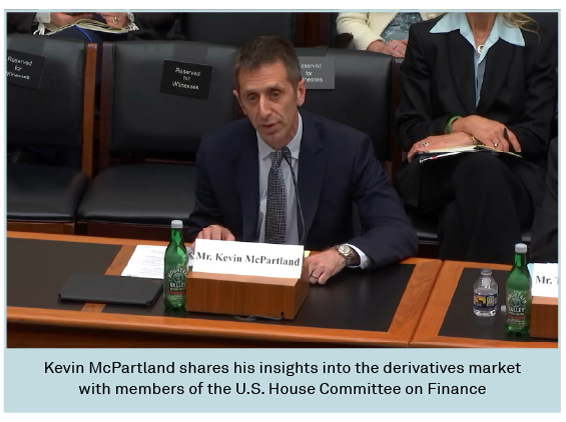
Testimony before the House Financial Services Committee
April 29, 2026
Thank you, Chairman Hill, Ranking Member Waters, and the members of the Task Force on Monetary Policy, Treasury Market Resilience, and Economic Prosperity for the opportunity to discuss derivatives and the U.S. Treasury market. My name is Kevin McPartland, and I am the Head of Market Structure & Technology Research at Crisil Coalition Greenwich.
U.S. Treasury Market Liquidity
The U.S. Treasury market remains one of the deepest and most liquid financial markets in the world. In 2025, the Treasury market saw an average of just over $1 trillion traded each day, up an impressive 60% from 2022. While this growth correlates with the increase in debt outstanding over the same period, the uptick in market activity exceeded what debt growth alone would suggest. Market turnover, measured as trading volume to debt outstanding, grew from 3% in 2022 to 3.8% in 2025, quantifying a true expansion of market activity.
The transparency of this critical market has also seen tremendous growth. We have transitioned from weekly volume reports in 2020 that included only primary dealer activity to the current reporting regime that provides public access to daily trading activity by market segment, and the details of nearly every on-the-run U.S. Treasury coupon bond traded each day. This has brought the Treasury market more closely in line with other U.S. securities and listed derivatives markets, ensuring that investors and market participants of all types and sizes have the information they need to make informed decisions.
Cyclical factors such as macroeconomic shifts and recent periods of volatility contributed to the market’s recent growth. However, increased participation, advances in electronic trading, improved access to data, a market structure that encourages innovation, and an increasingly robust derivatives market played an equally important role in the market’s recent expansion.
The Role of Derivatives
U.S. Treasury futures, in particular, are critical to keeping the Treasury market liquid. In 2025, the average daily traded value of U.S. Treasury futures equated to 93% of the value traded in the underlying bond market. They provide an efficient method for investors to manage their exposure, for banks to hedge positions obtained from trading with their clients, and for speculators to take the other side of those trades in hopes of generating returns, while simultaneously providing liquidity to the market.
The Treasury bond and derivatives markets are inextricably linked. We see strong futures and swaps markets not as competition for the U.S. Treasury market, but as catalysts for ongoing demand and growth. Bond traders and investors look to the futures and swaps markets as a cost-effective method of managing their exposure and the risk in their portfolios. Conversely, derivatives traders must often trade bonds in parallel, whether to hedge or to profit from pricing differences. This interplay between bonds and derivatives ensures that asset prices accurately reflect current market conditions, allowing long-term investors and large corporations to feel confident about their investment decisions and the United States to fund itself at the best possible rate.
Clearing and Capital Rules
The addition of a central clearing mandate for some Treasury bond and repo transactions can serve as a further tailwind for the market, with the potential to reduce systemic risk while simultaneously standardizing market entry and ongoing participation for market makers and investors alike. However, we must be careful not to disincentivize market participation when implementing this change by making the rules of engagement too onerous or the cost of trading too high.
Longer implementation timelines and the recently revised U.S. Basel III Endgame proposal suggest we’re heading in the right direction. Banks with more available capital to deploy to market-making activity, better incentives to hold Treasuries on their balance sheets, and greater recognition of cross-product netting are all critical to the market’s health and will act as tailwinds to Treasury market participation, liquidity and resiliency.
Conclusion
The Treasury market has experienced its fair share of shocks over the past decade. And it is a near certainty that unpredicted market dislocations will cause stress for some market participants in the years to come. As such, we should continue to pay close attention to areas of concentrated risk and leverage.
However, the shocks of the past few years have left us with a market that is more resilient than ever. Liquidity providers are better equipped to continue making markets when volatility spikes, end users have more access to better market data, and electronic-trading venue providers can ensure that markets continue to function as expected despite volatility-driven high volumes. This was most recently evidenced in March 2026, when the Treasury market averaged a record $1.4 trillion of bonds traded each day with no evidence of stress in the market’s plumbing.
With this foundation strongly in place, we look forward to a future that leverages common-sense oversight, new technologies such as tokenization and stablecoins, and market participants committed to ensuring the U.S. Treasury market remains liquid, transparent and efficient.