
Vibe coding is a big deal for capital markets
Despite the distinctly Gen Z name, vibe coding isn’t just for kids. More formally referred to as AI-assisted coding, this new way of doing an old thing is having a huge impact on financial services today and will have an even bigger impact tomorrow.
I’m not one to overstate the impact, good or bad, of innovation or market events. Calls for “the death of” things and talk of “game changers” generally turn me off. But this is different. The last change to coding that was this impactful was the move from punch cards to using a keyboard and monitor five decades ago.
For the uninitiated, vibe coding is the process of asking a GenAI assistant in plain language to build a program to do, well, whatever you want. “Get stock prices from Yahoo! Finance and create a market dashboard for me to track my portfolio” or “Create a web-based dashboard for me to keep up with my kids’ schedules” are both fair game. The results from a single prompt can be mind-blowing.
The code AI writes in a few seconds what would have taken hours, days or weeks the old-fashioned way. I graduated with a computer science degree in 1999, so I’ve experienced this firsthand. Not to mention AI’s ability to fix bugs. A prompt as simple as “this isn’t working” can be enough to fix programming errors that, again, might have taken hours or more to correct in days of yore.
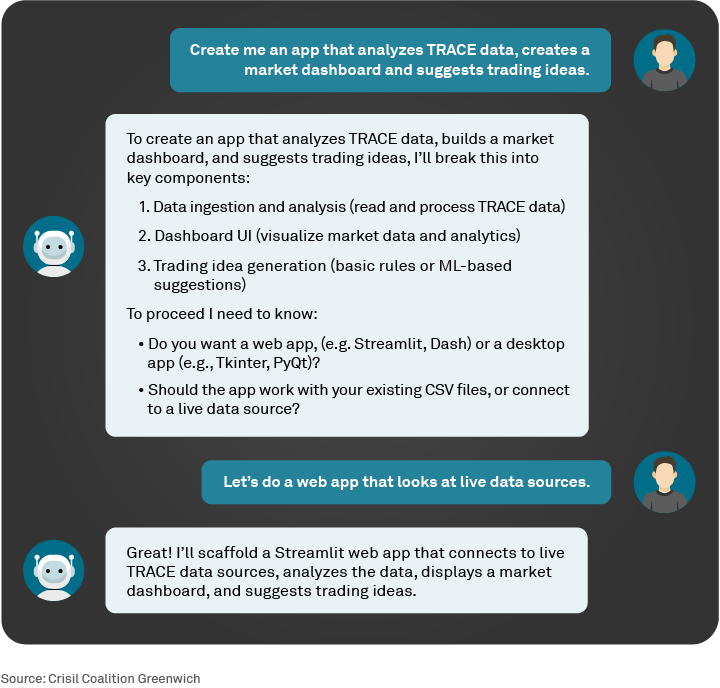
Even AI-assisted coding has made dramatic leaps in the past year. The first AI-coding process was to ask an AI chatbot to create code, that you would then cut and paste into your development environment. Today the process is agentic. You tell a “coding agent” what you want the app to do, it iterates on that idea to understand your request, creates a solution, and then automatically updates your full codebase, tests the results and deploys it to production. No further interaction required. Amazing.
What does this mean for capital markets? And for you in particular? Here’s what I’ve seen, heard, and experienced myself:
1. Data analysis
Excel is great at analyzing data, up to a point. Once the number of rows you’re examining gets into the thousands, let alone millions, Excel just doesn’t cut it. For a real-world example, the idea of parsing TRACE data at the trade level on my own was effectively impossible. I’m not a data scientist, I haven’t coded professionally in over 20 years. The only way to do that would have been to beg the data science and technology teams for a few hours to go through the data for me. That would have required knowing exactly what I was looking for, which, as we all know, often isn’t the case. That’s why they call it research.
Now it’s completely different. Using GenAI to write Python that ingests, cleans, analyzes, and visualizes data is easy and takes only a day or two to produce meaningful results. At roughly 300,000 trades per day, just one week of U.S. Treasury trades results in over a million rows and dozens of columns of data to analyze. AI-assisted coding lets you not only crunch that data in a short amount of time, but also easily ask follow-up questions about the results once you have the basic structure in place. The ability to analyze and then iterate on huge datasets is a game changer for analysts. Yeah, I said it.
2. Personal workflow solutions
I’ve tracked our team’s active projects and research calendar in a spreadsheet for nearly a decade. I tried a few off-the-shelf products over that time in hopes of using something more “enterprise,” but in the end, I could never get anything that felt flexible enough to support our processes and way of working.
Then one weekend, the lightbulb went off, and I realized I should try to build a tracker for our team using my new AI coding assistant. By Monday, I had a working version, and a few weeks later, we had a fully functioning calendar and project tracker, including personalized alerts for each analyst and reminders to add final details when reports are released. Now our research calendar is tighter, the team is better informed, and, hopefully, our clients are seeing an even better product.
Think of something you do every day, and then think about how you could automate it, or at least make it easier and faster. Five years ago, that would have required money or an IT team. Today, you can just do it in a weekend.
3. New product development and prototyping by the business
Stop writing functional specifications and mocking up screens in PowerPoint. That process can take weeks of writing and back-and-forth with IT before any code gets written. And sometimes you do not really know what you want until you see it. Then, the first request turns out not to make sense, and the spec writing, PowerPoint development, and iterations with IT all start over.
Now you can brainstorm with GenAI, including screen mockups, until you land on a design you like. Then you can go to your development team with at least a prototype and, at best, a near-functional version of the app you want.
This also lets more people across the firm create software to solve their own problems based on their particular needs and skills. A whole lot of that output may prove to be of limited value, but if even 30% of those vibe-coded solutions add efficiency or, better yet, revenue—the ROI is huge. This is not an aspirational development workflow built on tools that might exist someday. You can do this now. We are doing it here.
We must move forward carefully
The story of vibe-coding transforming markets isn’t without its challenges. All of this new code must also be managed within big and small financial institutions. If you’re of a certain age, you remember when trading desks were fully run on spreadsheets that only a single trader understood. If they broke, were deleted, or the trader left, it was bad news.
Eventually, the market and the world figured out how to keep an eye on, and maintain an audit trail for, those spreadsheets. Vibe-coded apps need the same thing. You should want your people to be innovative and creative, and not slow them down. But as these apps get closer to clients and production systems, some oversight, whether it be cybersecurity or data quality, is a must. This is a challenge even the most sophisticated firms are still working to solve.
Entry-level programming jobs are also at risk, with AI-assisted coding tools allowing one college grad to do what five did before. The silver lining, however, is that one college grad can now do what five did before. And imagine what a deeply experienced programmer can do with these tools. It’s like when Nike gave marathon runners carbon-plated shoes.
Among the AI slop and poorly coded AI apps that will hit the market will be incredible innovations developed in a time frame that even three years ago seemed impossible. Whether you’re building a fintech or sitting on a trading desk, if you’re not on the bandwagon, you’re going to fall behind. Give it a try. You will be amazed.