

Table of Contents

New futures contracts were created at a faster pace than exchange-traded funds (ETFs) this year, an interesting turn of events given ETFs’ rapid adoption since launching in 1990. The first listed futures traded in the United States in 1851, giving them a bit of a head start. The reference entity was 3,000 bushels of corn, and the contract was traded on the Chicago Board of Trade (CBOT, now part of CME). If you haven’t done the math yet, that was 175 years ago. You might think nothing new could possibly come from the futures market after all that time—but you’d be wrong.
Event contracts, compute futures, perpetual futures, and digital asset futures have all contributed to a renewed interest in the futures market and what’s possible via the nearly 200-year-old structure. More traditional, yet new, contracts are also moving the market forward, including credit futures, mortgage futures and loan futures, just to name a few. In addition to the new products, the surge of retail interest in the futures market, which has long been the domain of commercial hedgers, high-speed traders and sophisticated global financial institutions, is both a cause and effect of these recent innovations.
How ETFs and futures differ
ETFs have also been on an innovation spree. ETFs that track virtually everything, both long and short and with leverage or not, have become commonplace. You can use an ETF to bet on corporate bond borrowing to fund AI data centers as easily as you can use them to get exposure to Bitcoin or the S&P 500. Increasingly, however, the futures market can boast similar claims and, in some circles, is now getting more attention.
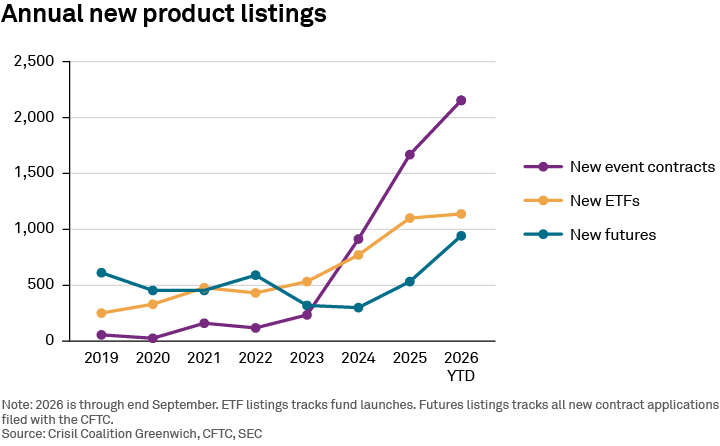
Of course, ETFs and futures are completely different things. They both provide exposure to an underlying asset or theme, but while futures are simply a contract between two people or entities, ETFs are actual investment funds with real assets and real investors. Furthermore, the former is much cheaper and easier to launch than the latter, which is why considerably more futures fail. Failing fast doesn’t cost much.
Nevertheless, futures have taken a lot of the air out of the room in the past year. While ETFs and futures launches have grown 367% and 386% since 2019, respectively, the Commodity and Futures Trading Commission (CFTC) filings for new futures contracts are nearly triple new ETF launches in 2026 YTD (September).
Events contracts explode
There is one big asterisk over that. More than 2,100 of the nearly 3,100 new futures contracts listed in 2026 are event contracts. And of those 2,100, over 60% are sports related. With event contracts taken out of the equation, the more complex and costly ETF launches have outpaced futures listings for every year but two since 2019.
Perpetual futures are in their early days but also starting to make a splash in 2026. There have been 161 “perp” filings with the CFTC in 2026 through October, up from 16 in 2025. Crypto-tracking perps is the biggest category with 86, equities contracts are close behind with 77, another 13 track commodities, and the final one is focused on U.S. Treasuries. Regulatory uncertainty still looms over this market, but a recent investment by ICE in growing this segment is a reminder it’s one to watch.

Understanding who is listing these futures contracts is also important. CME has unsurprisingly been active for decades, including over the past seven years, with new contract listings ramping up starting in 2022. Nodal Exchange is the other non-prediction market standout with its energy market focus. That said, the new listings are less about brand new products and more about updates to existing contracts based on the complexities of the energy market.

And while Kalshi was the only U.S. story in prediction markets in 2025, clarity from the CFTC coupled with a Kalshi win in court saw event contract listings in the U.S. spike. Polymarket, Robinhood, Interactive Brokers, and several others all began aggressive pushes into the space in hopes of catching retail investors’ attention, with sports being the big focus.
The crossover between retail and institutional
The data tells us that futures aren’t the new ETF. Unlike futures trading, this is not a zero-sum game. There are certainly market segments where both retail and institutional traders and investors should think closely about whether an ETF or a future better suits their goals: crypto, credit, energy, and interest rates just to name a few. Futures provide leverage and come with a theoretically unlimited supply. But ETFs act as a more efficient long-term holding, often making coupon payments and/or providing more tax-efficient returns.
Futures are institutional products that are being adapted for retail use. ETFs are retail products that, in some markets, have been adapted for institutional use. The crossover is good. It provides increasingly diverse views and liquidity that makes both markets stronger. And as for new listings, while more isn’t always better, and many futures and ETFs fail, the search for the next new thing that investors didn’t know they needed is what keeps financial markets moving forward.
Kevin McPartland is the Head of Research for Market Structure & Technology at Crisil Coalition Greenwich.
MethodologyCrisil Coalition Greenwich collected CFTC self-certification filings for new futures contracts and SEC filings related to new ETF listings from 2019 onward. We then analyzed the resulting dataset to assess trends in product launches over time and compare activity across futures and ETFs.