

"We want to be in private credit in the same way as we are in public markets"
Private credit and public credit markets are converging, and Bloomberg is accelerating its strategy to service this convergence by ramping up its data, news and enterprise solutions for private credit, stated Brad Foster, Bloomberg’s Head of Fixed Income and Private Debt, in a Behind the Market Structure interview with Kevin McPartland, Head of Research in Market Structure & Technology at Coalition Greenwich.
“Our strategy is driven by where our customers are focused. We want to be in private credit in the same way we are for our customers in public markets,” stated Foster, who has deep experience across the fixed income markets, having worked at Deutsche Bank for 16 years and over the last 9+ years at Bloomberg.
Strategic Focus
Bloomberg’s strategic focus on private credit follows growing allocations by asset managers and asset owners. It also anticipates rising demand for structured data and insights as customers seek transparency and unify their public and private portfolios. Having built a strong footprint across credit markets in bonds and bank loans, it is now “expanding that footprint to include private direct lending,” explained Foster. This includes building private direct-lending indices that would be in addition to its existing Business Development Company Debt Index, and working on providing “pricing on a lot more of that private direct-lending universe.”
“We're very focused on the corporate credit space, but we're also focused on bringing together public and private portfolios for our customers to represent that total portfolio view. We're focused on the data that services both the asset manager and asset owner requirements in the space,” stated Foster.
Sourcing the data
To support a total portfolio view, Bloomberg is ensuring that the “data and technology are completely interoperable between public and private” so that it can “provide customers with everything from position and exposure management to looking at attribution from a risk and performance perspective to building out our factor-based models,” explained Foster.
Unlike the highly transparent public bond market, however, the data for valuing private credit is not easily accessible.
According to Foster, a “decent portion” of the ~$2-trillion private direct lending market sits in U.S. business development companies (BDC). Bloomberg today is providing information on 15k+ private direct loan transactions through a combination of data it’s able to source generally, plus data from 10-K and 10-Q filing data for all traded and non-traded BDC on the Terminal. While a secondary market is starting to develop for larger private credit deals, Foster expects a majority of the private credit market, including many bilateral deals, to “remain private for longer” and will likely not trade.
Bloomberg is plugging this gap in part by collecting data directly from private credit investors and managers by incentivizing “our customers to bring their own data to us.” Stated Foster, “We're creating the uploaders, the permissioning and the entitlement so that when they bring that data to us, we respect its privacy.” and in return, customers will get access to fixed-income analytics from Bloomberg so that they can run the same calculation and analytics on these private credit loans as they can on bonds and broadly syndicated loans today. In addition, Bloomberg will provide a well-structured reference data and valuation service on these loans through Bloomberg’s Enterprise Data License and BVAL offering.
Public vs. Private
Is private credit growing at the expense of public credit? About half the corporate bond traders interviewed in a recent Coalition Greenwich study said that private credit markets are taking share from corporate bond markets, and that public and private market investments will blur over time.
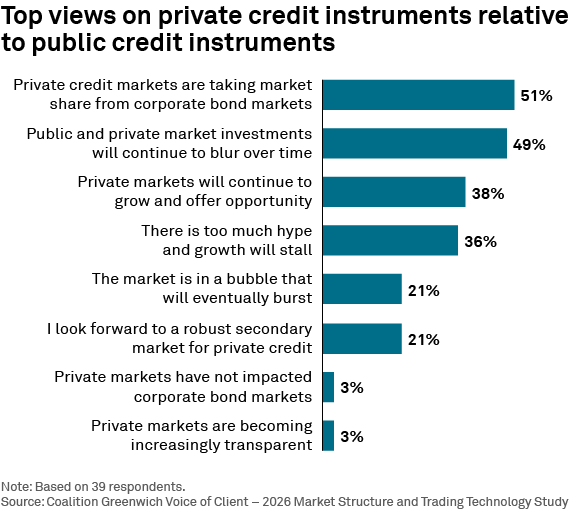
According to Foster, investment-grade borrowers are increasingly using “the flexibility private markets offer to diversify their funding sources” by refinancing out of the bond market and raising more flexible debt through private direct lending. The borrower base has shifted from private and more risky public issuers to include investment grade. In addition, the illiquidity premium between bank loans and private credit “has converged quite a lot.”
The view that public markets are liquid and private markets are illiquid is not always the case even in public bond markets “I think liquidity is relative to market conditions… You could make an argument that in a market downturn, when you go looking for liquidity, it's probably not as deep as you think it is,” said Foster.
What’s next
“We want to be where our customers are,” stated Foster. By bringing its “wealth of interconnected data and proprietary insights, making that foundational data completely interoperable between public and private markets” and by combining its data and analytics with enhanced technology, infrastructure and workflow solutions that will ultimately allow customers to make informed investment and risk decisions across public and private credit markets. Bloomberg, he added, is “doing all the right things to allow our customers to scale their own ambition into this private credit growth and not only manage the investment process, but manage their risk with confidence.”