
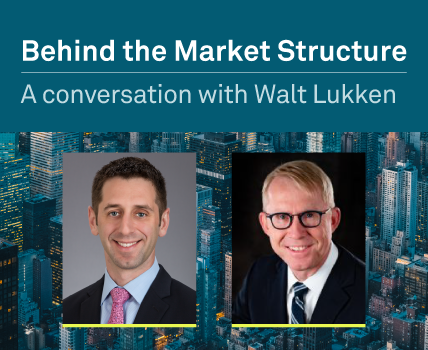
“It's super important that we have balance sheet capacity for resilience.”
“The derivatives markets’ rapid growth and operational efficiencies were evident in the ease of settlements of record trading transactions this March. Now, mandatory central clearing of U.S. Treasurys will further enhance efficiencies, while regulatory reforms on capital adequacy should add much-needed balance sheet capacity for further resilience,” said Walt Lukken, President and CEO of the FIA, in a Behind the Market Structure interview with Kevin McPartland, Head of Market Structure & Technology Research, Crisil Coalition Greenwich.
“We saw 88% higher volumes [following the Iran incursion] than during the Covid shutdown, and yet a 75% decrease in time to settlement. It was almost a yawn for the marketplace. To me, that feels like we're making good progress on the operational side,” said Lukken, pointing out that the 2020 record volume no longer figures in the top 100 trading days today.
Connecting the dots
As someone who studied business and law and who has been a market participant, Congressional staffer and regulator, Lukken’s diverse experience helps him “connect the dots to guide policymakers and hopefully make the right decisions for our markets.”
He helped legislate the Commodity Futures Modernization Act of 2000 as lead staffer on the Senate Agriculture Committee, was acting Chairman of the U.S. Commodity Futures Trading Commission (CFTC) during the global financial crisis, and headed the derivatives clearing house, New York Portfolio Clearing, before becoming the CEO of the FIA 14 years ago.
Now, Lukken is eager to see more balance sheet capacity being added in the cleared markets with the proposed Basel III reforms and U.S. Federal Reserve reforms on capital requirements for U.S. global systemically important banks (G-SIBs).
According to him, while Dodd-Frank succeeded in bringing more unregulated derivatives onto regulated clearinghouses to mitigate systemic risks, “the two policies started to work against each other where they were penalizing products that were going into clearing.” As a result, the industry was constrained by balance sheets and not allowed to take on new business because of restrictions on capital and risk.
“Hopefully, we can incentivize products into the safe environment of clearing and give capacity back to the market,” he stated.
Betting on growth
Meanwhile, the surge in trading volumes isn’t confined to the derivatives markets. Prediction markets are growing rapidly, too.
“If you talk to anybody under 25 years old, they love these markets because they're simple, they're understandable, they're predictive, and they work. So, it's really caught the attention of the younger generation,” pointed out Lukken.
Nevertheless, growth needs guardrails. According to Lukken, who witnessed the early academic experiments in prediction markets like with the Iowa political market during his tenure at the CFTC, two issues are central to the nascent prediction markets.
One is the “types of contracts”—such as sports betting or whether Taylor Swift is going to sing a particular song tonight—that a market regulator ought to oversee. “That is a public policy question for Congress, in my view,” he contends.
The other question is regulatory. According to Lukken, as the predictions market regulator, the CFTC needs to deal with how these products are self-certified and prevent market manipulation and insider trading.
For instance, he pointed out that risks for retail participants could rise if prediction markets “start getting more into leveraged contracts like traditional wholesale futures markets.”
“Our view is that should be limited for the retail community, unless these are really commercial products that can be risk-managed that the wholesale markets may be using,” he asserted.
Lukken expects these issues to get addressed as market participants, including the FIA, weigh in on them in response to the CFTC’s proposed rulemaking notice. “There are some growing pains. But I'm pretty confident within two years, [prediction markets] will start to institutionalize in really positive ways, even on the economic side that we haven't even scratched the surface of,” he said.
More than a token move
As prediction markets like Kalshi and Polymarket are starting to “institutionalize the things that TradFi exchanges and clearing houses have had for years,” the derivatives markets are exploring decentralized finance tools such as tokenization.
According to Lukken, the use case for tokenization is moving beyond clearing to post-trade collateral movement, given that the rise of the 24/7 crypto markets has raised questions on moving value during holidays or when payment rails are not open for other asset classes as well.
“I think tokenization is a potential solution, where you can move value at any time of the day or on weekends and you can derisk the system,” he stated, pointing out that clearing is not just about settlement. “There are open exposures of risk that remain with the contract all the time.” To derisk the system, markets need to be able to run the clearing system at all hours, and tokenization can “fix” that.
“Once we start to do that, it just removes the friction of moving value and quickens the time to clear those trades. So that's a positive. That's getting risk out of the system faster,” said Lukken.
He expects the industry to take three to five years to clear the operational hurdles to witness the practical benefits of tokenization. “It's exciting because I think ultimately, it's going to give more capacity back to the industry.”
Plus, it can be a “great use case” for digitizing public payment rails to speed up transactions and help address the question of 24/7 markets, he added.
Round-the-clock clearing for round-the-clock markets
Market integrity is crucial, according to Lukken. Hence, from a market structure perspective, if a market is going to move to 24/7, apart from the execution side, clearing also needs to move to 24/7. “You can't dislocate risk in the system on weekends or long holidays,” he stated.
According to him, most of the current solutions for clearing are to pre-fund, which is only a “bridge” and not the end game. “I think pre-funding is just putting risk with the clearing members and not the traders and commercial end-users… The risk should be on those that are taking the risk in the marketplace,” he said, pointing to the need to work with clearing houses to get to 24/7 clearing.
Equally, liquidity “is an important part of the equation,” he added. “This should really be demand-driven, product by product. Not everything should be 24/7.”
For instance, many commercial hedging products, especially in the agricultural space, need concentrated trading hours, according to him. On the other hand, demand has emerged for price discovery and risk management of energy products on weekends following the energy crisis in the Middle East.
“Where the FIA stands is that you’ve got to fix the clearing along with the trading,” asserted Lukken. Undoubtedly, given the various operational issues, there is no quick solution. “It's not an insolvable problem, but it just requires everybody to join hands and work on this,” he added.
Harmonizing the regulations
Meanwhile, the FIA will also be working on “harmonization” between the CFTC and Securities Exchange Commission over the course of 2026.
“We want to make sure that the markets are working well together,” said Lukken, who has testified before both regulators on this and was involved with lifting the prohibition on single-stock futures back in 2000.
“There's a variety of things we can do. I've suggested permanently putting the joint advisory committee of those agencies together, allowing them to do rulemakings on definitions… The tone from the top is, ‘Let's do it.’ That's great news. We can take some friction out of the regulatory system in the United States as a result.”