
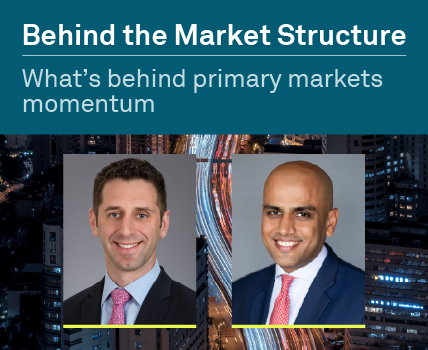
What's behind primary markets momentum
Large global investment banks with significant exposure to the technology sector and end-to-end execution services are the chief beneficiaries of the ongoing boom in primary markets. But the euphoria may taper off as upcoming issuances soak up demand and a high base effect comes into play in 2027, pointed out Gaurav Arora, Head of CIB, Public Analytics, Crisil Coalition Greenwich, in a Behind the Market Structure conversation with the firm’s Head of Market Structure & Technology Research, Kevin McPartland.
“We have seen banks report big numbers in the primary markets in the last two quarters. But the market recovery has been concentrated within specific sectors, so large banks which are more skewed toward those sectors have benefited from the growth,” stated Arora, pointing to their “inordinately high share of the fee pool.”
Capital raises across asset classes
The upsurge in primary markets, which were fairly dormant over the last three to four years, is largely driven by mergers and acquisitions (M&A) and the equity capital market, including mega issuances such as the SpaceX initial public offering (IPO) and South Korean semiconductor chipmaker SK Hynix’s sale of American Depository Shares (ADR). But the debt capital market has been active too.
“We've seen some big players that have not come to the debt markets for a very long time like Alphabet and Amazon coming with some jumbo deals as well,” pointed out Arora.
And while the technology sector led by the artificial intelligence (AI) story has grabbed the lion’s share, primary market activity has also been buoyant in sectors like healthcare, power and the geopolitics-driven energy space.
U.S. and Asian markets drive growth
In terms of geography, primary market growth in 2026 is largely driven by the U.S. market. Even within Asian markets, technology demand in the U.S. has been a chief trigger for capital raises, as in the case of SK Hynix, which garnered $26.5 billion through its ADR issue.
Said Arora, “The SK Hynix issue was interesting because you had such a big Asian corporate coming to the U.S. market driven by the AI demand for memory chips.”
Growing ancillary fee pool
The issue also highlighted the changing composition of investment banking fees. Not only did it have a large fee pool of ~$250 million across banks, but it was also not limited around issuance and underwriting services. Banks that played a big role in post-issuance, depository and cross-border execution services also got a share of the pie.
“Banks that are not just providing legacy underwriting services but giving a bear hug to the client and providing end-to-end execution have benefited from the ancillary revenues flowing through,” observed Arora.
Will the rally last?
“There is enough demand to potentially sustain this rally, and we expect the amount of capital raises to continue for the rest of 2026,” stated Arora. But it remains to be seen if the appetite is large enough to absorb more trillion-dollar issuances like those expected from Anthropic and OpenAI, he cautioned.
One indicator is the lower level of enthusiasm for longer-tenure bonds. “I think investors are still excited about the shorter tenure of the market because they see transparency. But they are getting a little bit more careful around anything beyond the short tenure.”
He added, “This gives us some indication that the exuberance driven by the AI rally is likely to taper off. It might not happen in 2026. But we do expect some sort of correction in the early part of 2027 because the bar has been set so high.”