
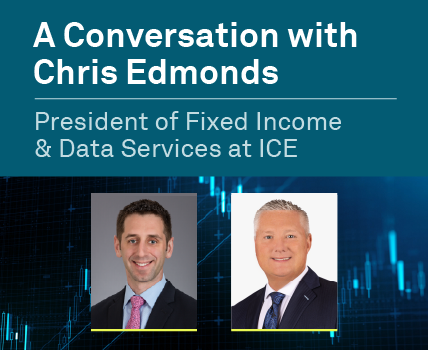
A discussion with ICE’s Chris Edmonds about prediction markets, sentiment data, mortgages, bonds, and clearing
The mainstreaming of prediction markets by financial institutions will improve market integrity over time, according to Chris Edmonds, President of Fixed Income & Data Services at Intercontinental Exchange (ICE), which owns the New York Stock Exchange. He spoke to Kevin McPartland, Crisil Coalition Greenwich Head of Research for Market Structure & Technology, at the NYSE headquarters on Wall Street.
“One of the interesting things we learn from sentiment data is where retail is going. What we often see from institutional markets is a confirmation of that retail signal. So, the better we can identify and package that signal for the institutional markets, I believe the better the market integrity becomes over the longer period,” said Edmonds.
Predicting market moves
ICE recently invested in prediction marketplace, Polymarket, and will distribute its event-driven sentiment data on market trends to customers globally. Early last year, the global provider of technology and data also entered an agreement with Reddit to leverage its Reddit Data API for data and analytics products. Plus, it uses sentiment data from sources like Dow Jones.
“Those are all opportunities for people to have consensus and then to be able to express a view in managing a risk that they deem appropriately. Nirvana for us, I think, will be [when] you see consensus develop through the Reddit sentiment data that comes through our feeds, and you see a market being made over here. And then, the feedback loop of that market back to the Reddit or our other communities is what will be interesting,” said Edmonds.
He expects prediction markets to mimic the crypto market’s growth trajectory from retail to institutional, and ultimately for both ends of the sentiment market to “collaborate to make a more seamless overall experience.” Incidentally, Edmonds consumes his news from multiple sources, from X and Reddit to financial news channels and live feeds, to look for the ‘delta.’ “I fear a world where there's only one opinion,” he noted.
Undoubtedly, evolution in data technology will be the key trigger for prediction market growth. “Our ability to make sense of all the noise out there is getting better. By pairing improvements we’ve seen in technology with our experienced data science teams, we’re able to process the massive reams of data that we’re receiving from our partners. So, for ICE, it's about how we package that and deliver it in an efficient manner, and in a way that’s useful for our customers.”
Bonded to technology
At the same time, ICE is looking to leverage its technology to expand retail participation in the corporate bond market through ETFs and index plays. According to him, less than 3% of bond market trades are a direct result of movement in an ETF or index fund, as compared to 31% in equities. “If you think about the normal construction of a portfolio, where 60:40 is equities to fixed-income products, you’d think this would be closer to parity. But that's the opportunity we have to inject the right level of technology. That opportunity for the market to grow and be much more widely distributed into instruments that folks can understand excites me,” he said.
Equally, he believes there is room for further growth in electronic trading of investment-grade and high-yield corporate bonds. The increase so far has been confined to actively traded bonds, which are a small slice of the 3.2 million bonds that ICE prices every day globally, he pointed out.
“It's a big sea to go fishing in to put together that right [portfolio] construction. I do believe there is much more opportunity for investors if we’re able to shed more light on some of the corners of the market that have been less actively traded in the past. Helping people find and value those bonds more easily can help bring more liquidity to that part of the market,” he said.
Mapping the risk on mortgages
Improved information, he added, has already expanded trading in mortgage-backed securities (MBS) by enabling people to become “a much better consumer and risk manager of those products in order to achieve the yield.”
For instance, ICE’s geospatial team has mapped every mortgage to every MBS, and every MBS to every municipality. “Think about that from an information play, say, in relationship to the Palisades fire or floods in North Carolina. Within hours, we can now show you the impacted muni bonds and MBSs in those zip codes… We're actually putting the climate risk on the screen, where you can see where the bid-offer is. And you're making a much more informed decision than before.”
Moreover, with more players assuming mortgage risk through MBSs, the opportunity for new home ownership will increase, he said. “That's what we're trying to help facilitate… Ultimately, the scorecard is can we drive down the price of home ownership and that's really what we stay focused on each day.”
Central clearing as catalyst
As for the upcoming central clearing for U.S. Treasuries and repo, every regulatory change has been a catalyst in increasing transparency, liquidity and electronic trading, and this time will be no different, stated Edmonds. “It's the way the movie has played out… You may make less per transaction, but you do incredibly more transactions, which creates a lot of opportunity.”
Additionally, central clearing in Treasuries will create opportunities for customers to access the market on their own terms, he added. “For the first time in quite some time, there will be choice, and customers will ultimately make that decision along the way. And we look forward to making our case.”