
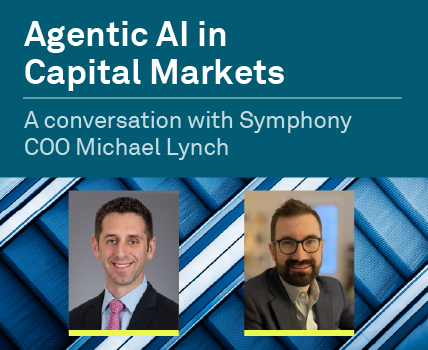
Workflow automation in the capital markets, which began with bots and has moved to GenAI-based copilots today, is set to adopt agentic AI with early use cases already emerging, according to Michael Lynch, COO of communication and market technology firm Symphony.
“We're starting to move toward the adoption phase. I think over 2026 – 2027, you'll see even more of agentic AI come in and complement the bots and copilots that are out there today,” Lynch said in an interview with Kevin McPartland, Head of Market Structure & Technology Research, Crisil Coalition Greenwich, at Symphony’s New York headquarters.
Bots and copilots versus AI agents
So, what’s the difference between bots, copilots and AI agents, and how are they automating capital market workflows?
According to Lynch, as an “automated component of a chat that can do a specific task,” bots are good at repetitive, low-complexity tasks such as pushing information. Symphony’s customers have built bots on its platforms to automate everything from post-trade workflows to “ordering coffee from the coffee machine in the lobby.”
“We have thousands of bots sending millions of messages a day, both intra-firm and inter-firm. We also have human-to-bot and bot-to-bot workflows,” Lynch stated. With manual workflows persisting in trading, “being able to deliver a bot into that workflow is still incredibly important,” he added.
Meanwhile, in today’s “copilot phase of the world,” users are utilizing GenAI platforms like ChatGPT internally to help them answer questions or create documents. These tasks are delivered off human prompting though. “If the human isn't asking them to do something, the copilots are waiting; they're not taking autonomous, proactive action,” explained Lynch.
An AI agent, on the other hand, takes the best of both these worlds. “It has a level of autonomy and ability to deliver toward a goal versus a task. Say, your goal is to resolve trades. You can create an agent, and if you give it the proper tools and data, it can do that as a companion to a human or sitting next to a human. While a human's doing another task, the agent can deliver toward that autonomous goal,” said Lynch.
Agentic AI as orchestrator
How does this work in practice? According to Lynch, while one AI agent may be engaged in conversation with a human, it could have multiple agents working behind the scenes. “This is where you get the concept of agentic AI, where different agents are responsible for different components. And there’s that orchestrator agent, who makes sure all those pieces of the puzzle happen in the right order and right time to deliver on the goal set at the beginning.”
Agentic AI needs guardrails to gain momentum
Undoubtedly, in the compliance-heavy capital markets, agentic autonomy needs guardrails—especially as, in principle, an agent can take data-based “risk and reward decisions” such as on Fed rates. That’s why the early users are mostly non-regulated entities, pointed out Lynch.
Symphony, too, is focusing on low-risk agentic workflows initially. It is also leveraging its experience of creating controls for financial institutions to build guardrails for agentic AI. Symphony Agent Studio is in the works, which will provide safe tools for creating agentic AI to big enterprises.
“With the right permissions, a user could free text prompt to say, ‘I want to create an agent that has this goal and can do these tasks using this underlying [internal or public Gen AI] model, datasets and tools.’ And the studio can create it, no code required,” said Lynch.
He expects market participants to increasingly drive agentic workflows, especially for low-risk, high-return work, once all the data controls and information barriers are in place for users to feel safe to experiment.
Early agentic AI use cases
Some use cases have already appeared, with some of Symphony’s partners delivering “truly agentic workflows” via its platforms. For instance, Kamba has built a data analyst agent that can look at various datasets and help users do financial and company analysis directly in Symphony. And Tradefeedr has delivered an agent that enables users to query their FX post-trade data for transaction cost analysis in Symphony.
Will voice data be the next frontier?
Can agentic AI resolve the notoriously tough problem of processing voice data? It will get there, believes Lynch. Symphony’s trader voice analytics product has made a start by not just transcribing trader voice conversations on its Cloud9 platform, but even categorizing them as “this was a trade, this was not a trade, this was a missed inquiry.”
“It is starting to give that insight downstream to the compliance officer, head of desk, etc. That [could] then become an input into a firm's agentic strategy,” said Lynch. Symphony is also working on making Cloud9 the “front door to a world of financial market voice agents,” where you can call an AI agent on Cloud9 and ask it to fix a problem. That could, he said, lead to the goal of processing voice data and unlocking “one of the last few black boxes in financial markets.”
Looking ahead
As use cases accelerate, Lynch expects agentic AI to evolve to the point where, say, a trade exception agent working with an operations team can help it hit the T+1 requirement, increase the straight-through processing rate, or speed up recovery when there is an exception. It could potentially identify what went wrong and resolve it or prompt the human on how to get it resolved.
“We can start to see those workflows… I never say never. We are a ways away from agents in financial market participation, but algorithmic trading is very much the standard today, and you could start to see how agents can augment and drive that flow over time as well.”