
U.S. public pensions: A large market entering a more selective phase
U.S. public pensions remain one of the most important institutional asset pools globally. These plans manage retirement assets for state and local government employees and continue to be a major source of demand across public equities, fixed income and private markets. For asset managers, however, market size is only the starting point; the more important question is where demand is moving and how well positioned they are to capture it.
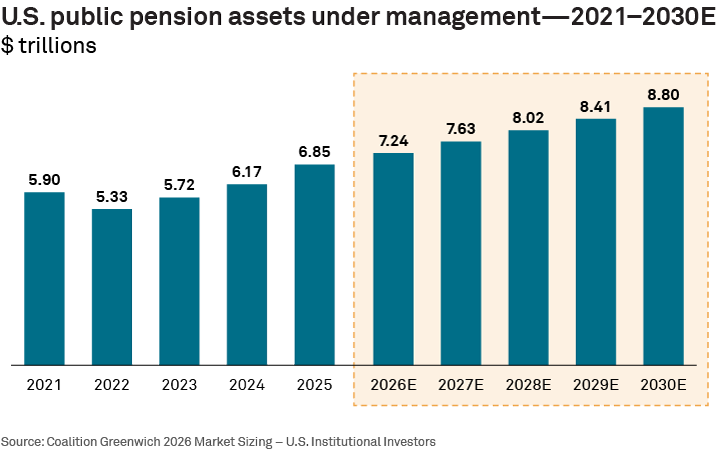
The U.S. public pensions market is expected to continue growing over the medium term, but at a more moderate pace. Public plans are mature systems, with annual benefit payments exceeding contributions. As retiree populations grow and average benefits increase, asset growth will depend heavily on investment returns, disciplined portfolio construction and the ability to manage liquidity needs.
An evolving landscape
Funding levels have improved in recent years, but many public plans remain below fully funded status. This creates a complex environment for investment teams. Plans need to generate sufficient long-term returns, while also managing downside risk, liquidity requirements and governance constraints. The result is a more selective market, where public pension investors are likely to focus not only on asset class exposure, but also on the quality, consistency and fit of individual managers.
Asset allocation is also evolving. Public equities remain a major part of public pension portfolios, while alternatives such as private equity, private debt, real estate, and infrastructure continue to play an important role in meeting long-term return objectives. At the same time, the role of fixed income has changed. With yields higher than during the previous low-rate cycle, fixed income is more relevant for plans seeking income, liquidity and portfolio resilience, even as growth assets remain important for meeting long-term return targets.
Private markets remain strategically important, but the bar for manager selection is rising. Public pension investors are paying closer attention to liquidity, valuation discipline, fees, transparency, implementation complexity, and the role each strategy plays within the total portfolio. As a result, demand is becoming more selective and increasingly tied to clear manager differentiation, implementation discipline and portfolio outcomes.
Opportunity for asset managers
For asset managers, the opportunity in U.S. public pensions, therefore, depends on more than overall market growth. Managers need to understand which strategies are gaining traction, where flows are moving, where they are underpenetrated, and how their competitive position compares with peers. This is especially important in a segment where consultants, governance processes and long-standing relationships can materially shape manager selection.
The Coalition Greenwich U.S. Institutional Market Sizing analysis brings these perspectives together by combining asset sizing, flows, product demand signals, allocation trends, and competitive positioning. This helps managers move beyond a static view of market size and identify where to focus product strategy, sales resources and client engagement.
To learn more, click here to request a preview of our U.S. public pensions market sizing research.