Table of Contents
The mainframe isn’t going anywhere. And despite senior banking executives embracing the cloud publicly, natural skepticism remains among CIOs, CTOs and mainframe executives about the cloud supporting everything.
Some of this is based on history. A bank built over decades of acquisitions, inheriting legacy infrastructure and core banking technology, tends to leave well enough alone. However, a “greenfield” or fintech bank is not constrained by legacy technology and can start with core banking in the cloud from day one. But the resilience of the mainframe is more than just old habits.
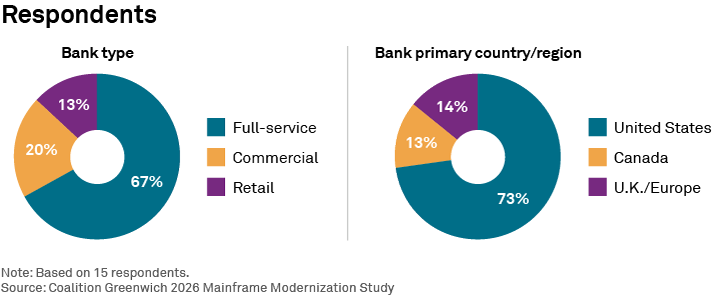
To understand how banks are approaching mainframe modernization, Crisil Coalition Greenwich interviewed 15 technology professionals at major banks in the United States, Canada, the United Kingdom and Europe. Their responses show why the mainframe remains deeply embedded in banking infrastructure, even as institutions expand their use of cloud computing and artificial intelligence (AI).
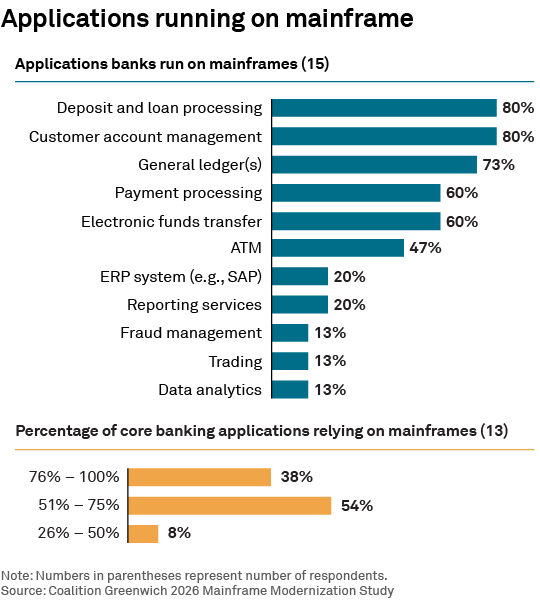
Consumer banking applications (e.g., deposits, loans, payments) are heavily deployed on mainframes, and banks contend they will remain there, despite modernization initiatives. Furthermore, senior executives at the largest banks are often the biggest proponents of “staying the course,” preferring to migrate only 5% of applications off the mainframe each year. This means most CIOs/CTOs will retire before any mainframe plans are abandoned, with the question of balancing mainframe use versus the cloud to be inherited by millennial and Gen Z professionals.
However, CIOs/CTOs don’t have their heads in the sand. They are open to the benefits of cloud computing but haven’t always seen those benefits realized. For instance, upgrades to the latest mainframes can happen over a long weekend without much focus on the banking applications at all. To the delight of many application developers and banking executives, applications written for the mainframe don’t have to be rewritten for new mainframe infrastructure.
Conversely, cloud migrations often require massive recoding efforts so that legacy applications can operate in a virtual environment. Mainframe budgets are also set in long, three-year cycles. Capex spending is planned for and available versus swapping to an opex model for on-demand cloud capacity.
The impregnable mainframe
The benefits go beyond retail banks. Mainframes are widely used by diversified global banks, including those with investment banking and capital markets operations. Our research found that many executives cited usage in treasury functions, securities processing and even some inherited legacy investment-banking applications running on mainframe. While we are not advocating for investment banks and trading firms to migrate to mainframes, in many cases it makes sense to leave legacy applications running on the resilient, reliable and impregnable mainframe.
Our interviews further confirmed that mainframes remain a vital component of banking IT infrastructure, including at banks active in capital markets. Executives consistently described the technology as robust, reliable and scalable, particularly for core banking workflows. Mainframes provide high-volume transaction processing, reliability, uptime, and security. Additionally, core banking applications are highly concentrated on these systems, with more than 50% of applications running on mainframes, and some banks reporting concentrations above 75%.
Modernization initiatives don’t always challenge mainframes
Banks generally plan to modernize mainframe applications rather than migrate them en masse to the cloud. Among respondents, 27% plan to modernize legacy applications while remaining on the mainframe, and 20% plan to maintain their current applications without expanding them. By comparison, 13% plan to migrate all software and applications off the mainframe, while another 13% plan to phase out and decommission the platform.
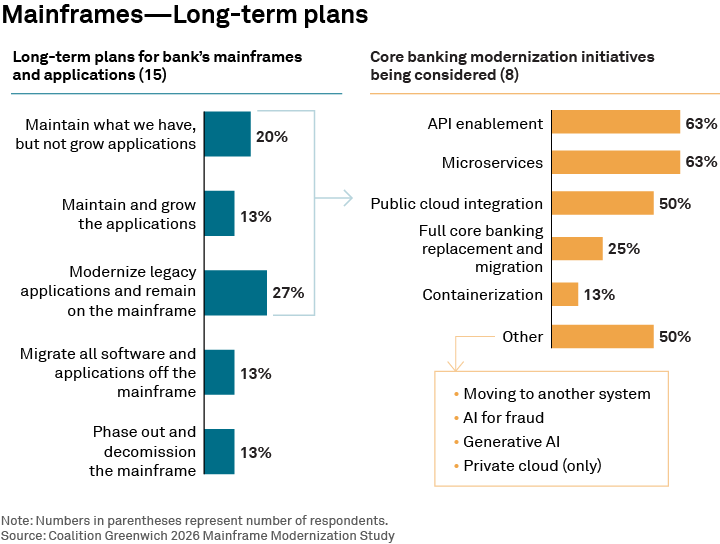
Among the core banking modernization initiatives being considered are API enablement, microservices and public cloud integration, but only 25% are doing a full core banking replacement and migration.
Where AI workloads should run
Then there’s AI, which is commonly cloud-deployed for both consumer and commercial banking applications. Sometimes lost in the conversation, however, is that AI capabilities exist on the mainframe itself. IBM, still the largest mainframe provider by a large margin, has developed AI capabilities for mainframe, including fraud prevention, a key use case, as credit card transaction data often resides on a mainframe.
However, not all banking executives are focused on or know how to use these new AI capabilities and need to be educated. Over the next few years, AI capabilities on the mainframe could make the platform more useful for certain banking applications, even as cloud computing adoption continues to expand. CIOs/CTOs are avoiding adding unnecessary latency to critical functions and should preserve the mainframe’s inherent advantages for data at rest, including encryption and data compression.
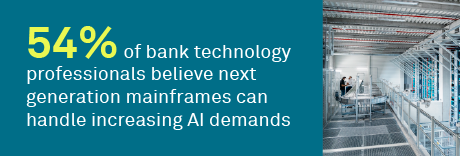
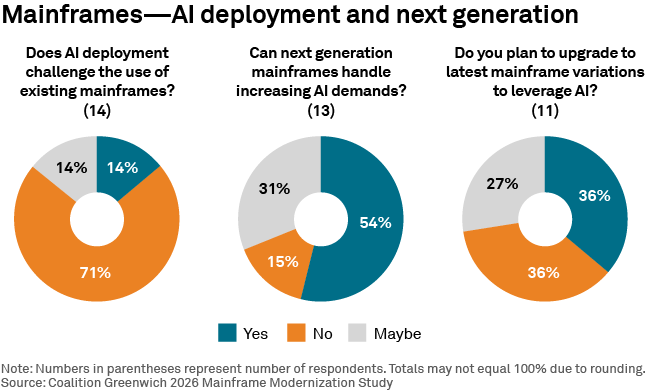
For banks, the near-term AI question is less about whether the technology will replace mainframes and more about where AI workloads should run. Some executives are not yet considering AI for core banking applications, while others see potential benefits but do not expect AI to change their infrastructure choices. More than half believe their mainframes can accommodate increasing AI demands, although the latest AI capabilities are not yet driving technology decisions. For now, banks continue to value the mainframe more for resilience and dependability than for speed of innovation: more tank than Ferrari.
Where to go from here
The likely end state is not a choice between mainframe and cloud, but a hybrid environment in which each supports the workloads it handles best. Banks will continue modernizing core applications on mainframes, while using cloud infrastructure where it provides greater flexibility, speed or access to new capabilities.
David Easthope advises on market structure and technology globally.
MethodologyCrisil Coalition Greenwich conducted phone interviews with 15 highly qualified technology professionals at banks in North America and the United Kingdom and Europe. Interviews took place from December 2025 to February 2026 and were spread across leading global banks, regional banks, and smaller retail and commercial banks to offer a balanced perspective.