

Table of Contents

Australia’s transition to real-time payments
Australia’s payments landscape is undergoing a significant transformation as the industry moves towards real-time payments. This transition represents more than a change to payments infrastructure. It creates new opportunities for organisations to improve payment processes, strengthen liquidity management and uplift customer experiences.
New research conducted by Crisil Coalition Greenwich, in partnership with Australian Payments Plus (AP+), provides an assessment of where Australia’s largest corporates are on that journey.
Based on responses from senior finance and treasury leaders, the research examines awareness of the industry’s longer-term intent to transition away from the Bulk Electronic Clearing System (BECS), the levels of planning and preparedness among large corporates, and the opportunities and implementation considerations associated with moving to real-time payments.
The research reveals growing awareness of payments modernisation, with more large corporates moving beyond awareness and into planning and preparation for the transition.
Finance and treasury leaders identified opportunities extending well beyond faster payments, including always-on payment availability, improved liquidity management, more efficient reconciliation, and better customer, supplier and employee payment experiences.
At the same time, the research highlights that realising these opportunities will require thoughtful planning across technology, business processes, controls, and organisational change.
Together, the findings point to growing momentum as more Australian corporates prepare for their transition to real-time payments.

Corporate Australia is increasingly aware of the transition
Australia’s payments landscape is evolving, with real-time payments set to play a central role in the future of corporate payments. At the centre of this shift is the NPP (New Payments Platform), Australia’s real-time payments infrastructure.
As a modern alternative to the Bulk Electronic Clearing System (BECS), the NPP enables data-rich payments to be processed and settled in near real time, 24 hours a day, 7 days a week, 365 days a year.
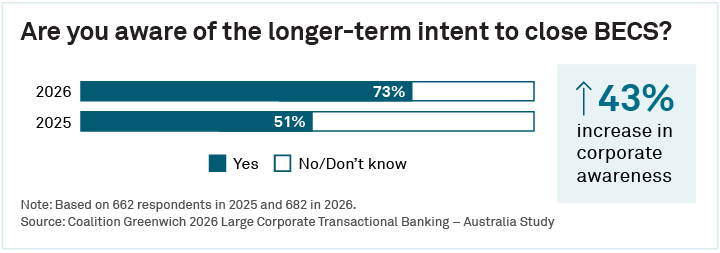
Awareness of the industry’s longer-term intent to transition away from BECS is becoming increasingly widespread across corporate Australia. Today, nearly three-quarters of Australia’s largest corporates are aware of the proposed transition, a 43% increase compared with last year.
Awareness is growing
While corporates with annual revenue exceeding $3 billion continue to report the highest levels of awareness, awareness is becoming more widespread across organisations of all sizes.
Likewise, awareness has increased across all industries. While this uplift is broad-based, several sectors are leading the way, with transport, technology, media & entertainment (TME), insurance, and financial institutions demonstrating the highest levels of awareness.
Banks are building awareness
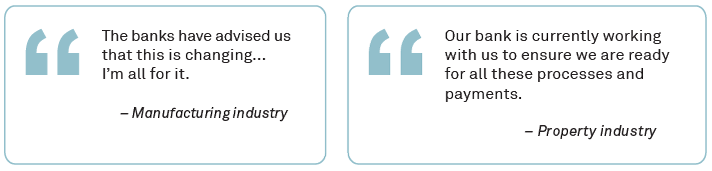
Banks have become an important source of information about payments modernisation. Over the past 12 months, many corporates have received communications from their banking partners regarding the move to real-time payments and the capabilities of the NPP.
For some organisations, enterprise resource planning (ERP) upgrades and broader technology transformation programs have also provided a natural opportunity to consider payments modernisation as part of existing change initiatives.
Together, these discussions are helping organisations better understand the implications of the transition, the opportunities presented by real-time payments and the practical steps involved in preparing for change.
Moving from awareness to action
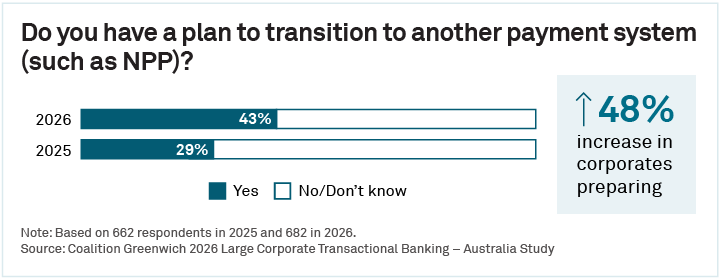
Growing awareness of payments modernisation is translating into planning and preparation. Substantially more Australian corporates have begun planning for the transition compared to 2025, with 43% now reporting they have a plan to transition their payments to another system such as the NPP.
Corporates are at different stages
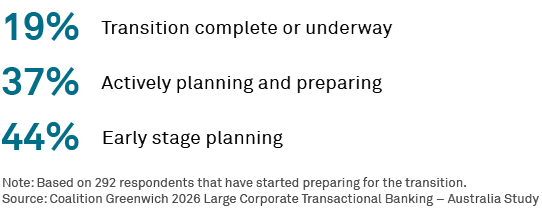
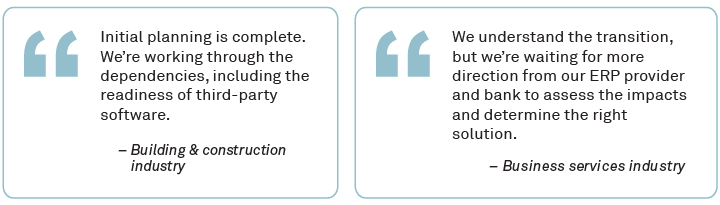
Among the organisations that have begun preparing for the transition, levels of readiness vary.
Planning momentum varies across the market
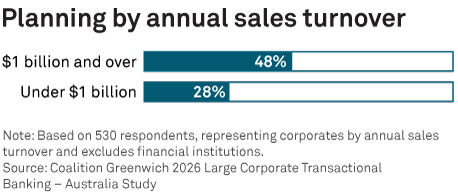
Larger organisations are generally further advanced in preparing for real-time payments, with nearly 48% of corporates with an annual turnover of $1 billion and above having begun planning, compared with 28% of organisations with an annual turnover below $1 billion.
Corporates recognise the benefits
The research shows that finance and treasury leaders see opportunities extending well beyond just the speed of payments. Organisations recognise opportunities to strengthen liquidity management, support finance transformation, enhance customer experiences, and improve payment security.
1. Settlement speed and availability
Accelerated settlement and always-on payment availability emerged as the most widely recognised benefits in the research.
Half of large Australian corporates reported that their organisation would benefit directly from these capabilities.
Respondents identified the removal of payment cut-off times, greater flexibility over when payments are made and received, and the potential for faster cross-border payments as some of the most valuable opportunities associated with the transition.
2. Liquidity and cash management
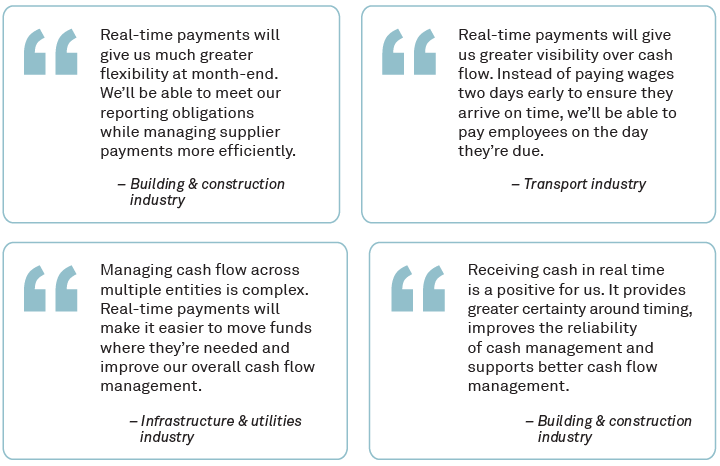
The potential for real-time payments to optimise liquidity management through faster access to funds and greater cash flow visibility emerged as a key theme.
Respondents identified immediate access to incoming funds as a key enabler of improved working capital efficiency and reduced idle cash balances. They also highlighted enhanced visibility of payment flows and greater certainty that payments have been received as supporting more accurate cash forecasting and better-informed treasury decision-making.
3. Supporting finance transformation and automation
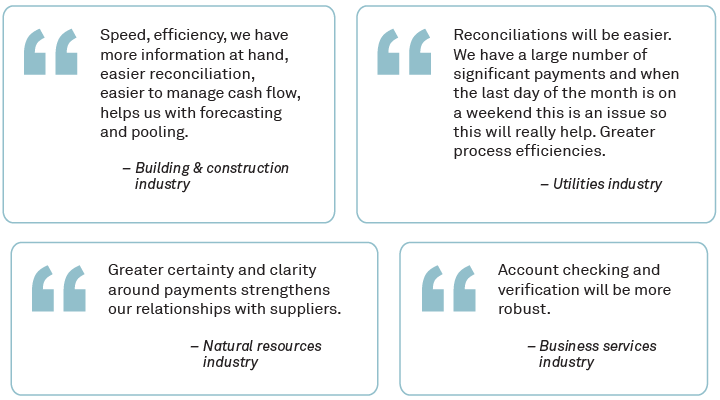
Many identified opportunities to modernise finance operations through richer payment information, more efficient reconciliation processes and greater automation.
Respondents highlighted the potential for improved payment data and visibility to streamline back-office processes, reduce manual intervention and support automation across finance operations.
A transition also enables organisations to take advantage of ISO 20022, the global financial messaging standard, supporting greater alignment with international payment systems.
4. Improving experiences for customers, suppliers and employees
Corporates recognised that real-time payments have the potential to improve interactions with customers, suppliers and employees.
Faster payments, greater payment certainty, immediate payment confirmation and improved visibility over payment status were identified as important factors in creating better payment experiences.
Respondents also highlighted payroll and payday super as opportunities, recognising the benefits of more timely salary and superannuation payments, greater certainty around payment timing and an improved experience for employees.
5. Improving payment security
Some also identified opportunities to strengthen payment security and financial crime controls through richer payment information, together with capabilities such as Confirmation of Payee supporting stronger account validation.
Implementation considerations
While corporates recognise the opportunities presented by real-time payments, respondents also identified a number of practical implementation considerations that will need to be worked through as they prepare for the transition.
Technology integration, organisational change, controls and risk management, and business case development emerged as the key areas of focus.
The nature of these considerations varies depending on where organisations are in their transition journey. Those in the early stages are primarily focused on planning and readiness, while organisations further advanced are increasingly turning their attention to implementation and organisational change.
1. Technology integration and operational readiness
Technology integration emerged as one of the most commonly identified considerations. Organisations highlighted the need to integrate real-time payment capabilities into ERP platforms, treasury management systems and existing payment workflows.
Many also recognised the importance of internal technology resources, specialist expertise and thorough testing to support a successful implementation.
2. Managing organisational change
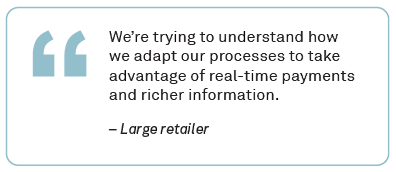
Beyond technology, many organisations recognise that successful adoption will require changes to business processes and ways of working.
Real-time payments have implications across treasury, finance, operations, customer service and supplier management, requiring updates to processes, controls and operating models. Many organisations indicated they are planning a phased implementation approach to help manage organisational change and minimise disruption.
3. Controls and risk management
Some organisations also identified the need to review payment controls and risk management practices as part of the transition.
Respondents recognised that faster, irrevocable payments require greater confidence that payments are authorised, accurate and being sent to the intended recipient. As a result, many organisations identified the need to review payment approval processes, fraud controls and operational governance as part of their transition planning.
Capabilities such as Confirmation of Payee were recognised as supporting stronger payment controls by providing greater confidence that payments are being sent to the intended recipient.
4. Building the business case
Developing the business case also emerged as an important consideration. Respondents recognise that transitioning to real-time payments will involve investment in technology, integration and organisational change.
Many CFOs and treasury teams are evaluating the expected benefits alongside implementation costs to determine the most appropriate transition pathway for their organisation.
Some respondents identified value in aligning payments modernisation alongside planned ERP implementations or system upgrades, allowing future payment requirements to be addressed as part of broader transformation initiatives.
Preparing for the transition
The research highlights that organisations are at different stages of preparing for real-time payments. While every organisation’s transition pathway will differ, the findings suggest several practical actions that organisations can take as they prepare to adopt real-time payments.
Engage with banking and technology partners
Many organisations reported that banks are already playing an important role in building awareness of payments modernisation and helping them understand the implications for their business.
Early engagement with banking partners, payment service providers and technology providers can help organisations better understand the impacts on payment processes, business systems and implementation planning, while identifying opportunities to align the transition with broader business priorities.
Build a transition roadmap
The research identified technology integration, organisational change, controls and risk management, and business case development as important considerations associated with the transition. Together, these findings highlight that preparing for real-time payments extends beyond technical implementation and requires coordination across multiple business functions.
Developing a transition roadmap can help organisations assess the impacts on systems and processes, prioritise implementation activities and plan the transition in a structured way.
Where organisations are already planning ERP implementations, treasury system upgrades or broader technology transformation initiatives, there may be opportunities to incorporate payments modernisation into these programs rather than treating it as a standalone project.
Focus on business outcomes
The research shows organisations see value in real-time payments across a range of finance and operational processes, from improving payment flexibility and cash flow management to supporting finance transformation and enhancing customer, supplier and employee experiences.
Identifying the business outcomes an organisation is seeking to achieve can help prioritise the use cases that will deliver the greatest value and ensure the transition is driven by business needs rather than technology alone.
Conclusion
The Crisil Coalition Greenwich and Australian Payments Plus study highlights growing awareness of payments modernisation among Australia’s largest corporates, with an increasing number of organisations beginning to prepare for the transition to real-time payments.
The research also highlights that, for many finance and treasury leaders, the move to real-time payments represents more than just faster payments. Organisations identified opportunities to improve payment processes, liquidity management, finance operations and payment experiences, while recognising that successful adoption will require planning across technology, people and business processes.
While organisations are adopting real-time payments at different rates, the findings suggest momentum is building as more corporates move from awareness to planning and preparation.

Ian Andrews and Joshua Lake are the authors of this report.
About the research
The findings are based on research conducted by Crisil Coalition Greenwich between February and April 2026. The study included interviews with 682 Australian organisations, comprising large corporates with annual turnover exceeding AUD 500 million and institutions managing more than AUD 10 billion in funds under management. Where relevant, results are compared with findings from the 2025 study, enabling year-on-year analysis of corporate awareness and preparedness for payments modernisation.