

Table of Contents

Most CEOs spend a lot of time thinking about the price of their products versus competitors. Since most financial advisors act as the “CEOs” of their own practices, it would make sense to assume that they also spend a lot of time thinking about how they are pricing their services.
Nothing could be further from the truth. In reality, most financial advisors avoid the topic of pricing because it makes them uncomfortable. Advisors fear that any conversation about pricing with a client will damage their relationship and potentially lead to attrition. And most advisors lack the resources and skills to determine appropriate pricing, and find it challenging to communicate their value alongside their fees to clients. As a result, many advisors fall into the “set-it-and-forget-it” trap. They establish a price up front and rarely revisit it, in some cases for decades.
Many wealth firms today are realizing the benefits of proactive pricing management, and investing in Price & Value Management Programs. These programs combine market pricing intelligence, advisor training and governance frameworks that help advisors set, explain and review pricing in a way that aligns with client value. These programs are effective for one primary reason: They establish the clear connection between the value advisors are generating for clients and the price clients pay for their services.
Building a Price & Value Management Program doesn’t take decision-making away from advisors—instead, it empowers and rewards better pricing decisions by advisors. Investing in a Price & Value Management Program is a way to support advisors in a task that is inherently difficult, and we believe those investments offer direct, measurable results and a high return on investment.
This report outlines five reasons why wealth executives should consider building or expanding their centralized pricing capabilities through a Price & Value Management Program.
Benefits of a Price and Value Management Program

1. Protect and grow economic value
Price and value are intrinsically related. Effective pricing structures provide advisors with the resources they need to maintain current value and invest to enhance value in the future. When those enhancements enable real value creation, the improvement should be reflected in a parallel move in price that increases revenues, facilitating additional investment. In other words, the price advisors charge should be tethered closely to the value their services create for clients.
Firms that optimize pricing also create a critical buffer for margins. Wealth management is a business with sizable fixed costs. As a result, increases in pricing have an amplifying effect on profitability, meaning that a 1% increase in price will have a greater than 1% impact on profitability. Clearly, the inverse is also true. Given high fixed costs, decreases in wealth management pricing will disproportionately reduce profitability—a key consideration for any firm tempted to cut the price of full-service advice as a means of maintaining market share or otherwise competing against discount brokers, robo-advisors and other low-cost rivals.
These simple observations demonstrate that senior leaders of wealth management firms should be spending at least as much time on pricing as they do on expenses, and possibly even more.

2. Reinforce a premium brand
Price helps define the brand. Behavioral economics demonstrates that consumers are hardwired to believe that more expensive products are of higher quality. Consumers jump to the conclusion that ‘you get what you pay for’ because, in most cases, it’s true. Generally speaking, the services of a more expensive professional—be it an accountant, a lawyer or a consultant—will be superior to those of a lower cost one.
Clients, particularly wealthy ones, are used to paying high prices to ensure they are getting high-quality products—cars, homes, vacations, restaurants, medical care, etc. The same is true in wealth management. Your price doesn’t just determine what you’ll earn, it sends a message to your clients and prospects about the value of working with you. For firms and advisors who offer a premium proposition, charging an average or low price will confuse prospects and undermine your brand positioning.
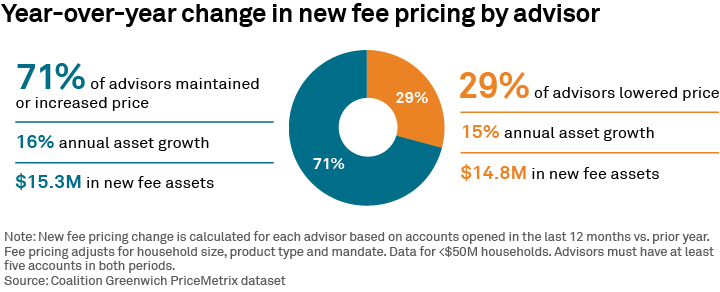
In fact, advisors participating in our study who raised prices actually added more new assets than those that lowered price.

3. Respond to changing client attitudes toward advice
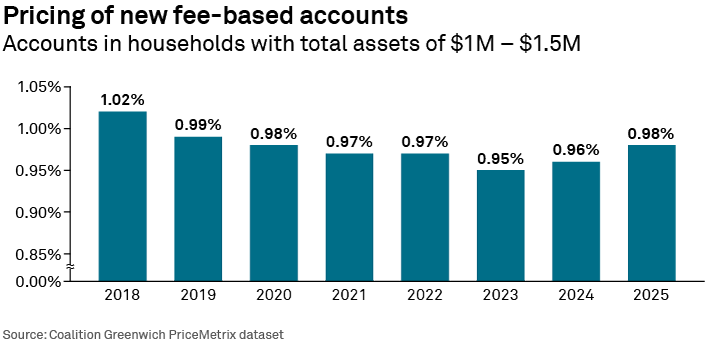
After a long period of declining prices for wealth managers, the industry is finally experiencing a period in which aggregate price levels have stabilized and are starting to rise. This increase is seen broadly, across the majority of wealth segments.
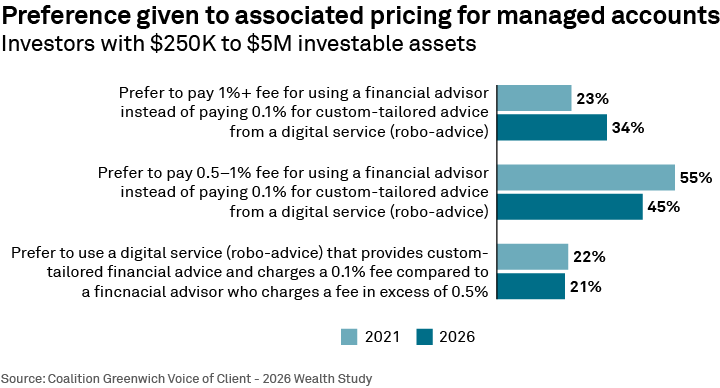
Pricing levels are rising in part because clients are simply willing to pay more for advice. Nearly 80% of clients say they are willing to pay for investment advice—a consistent trend over the last 5 years—and the share of clients that say they are willing to pay a premium for advice has jumped to approximately 34% in 2026 from 23% in 2021, an increase of 48%.
A key reason that clients are often more willing to pay for wealth management services is that wealth management—as a service—has become broader, more holistic and more capable of creating value for clients. Relative to even the very recent past, advisors are offering new types of investment products, enhanced financial and estate planning, and connecting clients with a broader ecosystem of service providers.

4. Correct pricing blind spots with data
Advisors believe several things about pricing that are simply wrong:
- If they raise prices, many of their clients will leave. (Client relationships are often more resilient than advisors expect.)
- Clients like getting discounts. (Discounts are not always as influential as advisors assume.)
- Pricing is constrained for some advisors because they work in a highly competitive geographic market. (There is no relationship to price levels or price elasticity and geography.)
- Ultra-high-net-worth clients are more price-sensitive than mass affluent ones. (Affluent clients are used to paying for quality.)
Most importantly, many advisors underestimate how much value they create for clients, how important their advice is to clients and how much clients are willing to pay for their services. This tendency to undervalue the service advisors provide is reinforced by ad campaigns from discount brokerages that openly attack the “high prices” that advisors charge and question the value of premium advice.
All these mistaken beliefs have a real impact on industry economics, because they make advisors willing to capitulate on price or avoid talking about price with clients in the first place.
Above-average service for below-average price
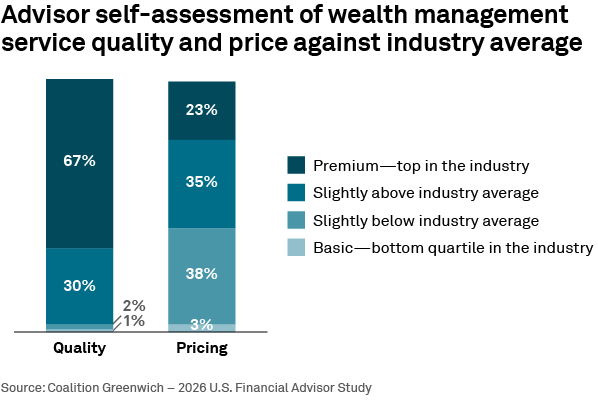
In our recent study, advisors were asked if they believed their value proposition was above average compared to other wealth advisors. An overwhelming 97% believed they offered “premium” or“above-average” advice.
Although that assessment is obviously misaligned for some of those advisors, it reveals something important about the industry when compared to another study finding. When the same group was asked if they thought the price they charged clients was above average, only 59% said yes.
Those results reveal that 40% of advisors are consciously offering above-average services at below-average prices.
These findings show the need for better pricing visibility across the industry. Advisors today lack data that would allow them to compare their services and pricing structures with those of competitors. One of the central roles of a Price & Value Management Program is to ensure that advisors validate their pricing and their relative price positioning on concrete, reliable competitive pricing data.

5. Improve advisor confidence and client conversation
The last thing most advisors want to do is have a conversation with a client about pricing—especially a conversation about a price increase.
Conversations about pricing are awkward, uncomfortable and can make advisors feel like they are being crass or pushy by bringing up money. Some advisors have an even more emotional aversion to discussing pricing, based on the mistaken belief that increasing prices is at odds with their fiduciary responsibility and that pricing is a zero-sum game in which higher prices mean they win and their clients lose.
Most of the hesitation around a price conversation is based on advisors’ seemingly rational concerns about alienating and losing clients. Like all humans, advisors place a disproportionate weight on the fear of loss. As it relates to pricing, this means that the advisor places a higher value on the risk of losing clients and prospects than they place on the increased benefit of more appropriate pricing.
To avoid these difficult conversations, many advisors adopt a “set-it-and-forget-it” approach to pricing, often going years before evaluating and recalibrating price levels. This is a mistake: Autopilot is not a viable pricing strategy.
The solution: Price and Value Management Program
Although decisions and discussions about pricing don’t come naturally to most advisors, advisors can learn the right way to manage pricing in their practice. A Price & Value Management Program brings a combination of direct training, smarter policies and tools that better inform pricing decisions with accurate data.
When training an advisor on how to approach pricing, we recommend starting with two key points:
- Clients want open and honest conversations about price
- Price is intrinsically linked to value
Clients today value transparency, and transparency builds trust. Advisors should be having regular conversations with clients about the services they offer, the value they deliver, and how the advisor and the firm are investing and improving to provide even more value in the future. These check-ins should include discussions about how price structures and levels are set, and how those price levels reflect value. Clients want to understand what their advisor is doing for them and how they benefit. Clients also want confidence that their advisor is investing in the capabilities, expertise and resources needed to serve them effectively.
Establishing a habit of holding regular, open conversations creates a smooth path for introducing the topic of price changes when needed. The key is to ground that discussion firmly in the context of services provided and value. Any adjustment in cost should be connected to a parallel adjustment in value driven by concrete changes the client can see and understand. Those changes can include access to more or better-quality services, a change in team that deepens expertise, or other enhancements that are currently taking place or have already been implemented.
Advisors should never tell clients that they have been underpriced. Instead, they should explain how the overall offering has improved, how the client is directly benefiting, and how those changes will be reflected in price.
Of course, it’s not enough to be able to speak convincingly to clients about price. Advisors owe it to clients to ensure that pricing is fair, and that the money a client spends on their advice is actually delivering a meaningful and measurable benefit. This is the role of the Price & Value Management Program.
An effective Price & Value Management Program uses accurate data to ensure that pricing is in line with value creation. By informing advisors’ own understanding of price levels with credible data, these programs will help dispel myths about pricing, assuage fears about discussing price, and build skills and confidence in client conversations. Together, these new strengths will encourage advisors to initiate regular, honest and open discussions with clients around price and value.
At a firm level, many functions and departments—including technology, product management, practice management, regulatory, and field management—hold some responsibility for effective pricing management. An effective program will coordinate these efforts, bring much-needed accountability and create an effective, permanent mechanism for price optimization.
Pricing is one of the most powerful yet least actively managed levers in wealth management. Firms devote enormous energy to managing costs, acquiring clients and improving productivity, yet many still leave one of the largest drivers of value creation largely to instinct and habit. A Price & Value Management Program replaces intuition with data, equips advisors to have more transparent conversations with clients and helps ensure that price, value and client outcomes remain aligned.
For wealth management leaders, developing a deliberate approach to pricing is increasingly becoming a strategic necessity rather than an operational consideration. The question is no longer whether pricing matters, but whether the firm has the capabilities, discipline and governance to manage it effectively. Firms that leave pricing “unmanaged” risk creating a growing disconnect between the value they deliver and the value they capture, ultimately limiting their ability to drive growth, strengthen client relationships and invest in future capabilities.
Kieran Bol and Nathaniel Brown advise our wealth management clients in North America.
MethodologyThis report is based primarily on the PriceMetrix proprietary database collected from wealth management firms across North America (U.S. and Canada). Our data includes detailed client holdings and transaction information from over 80,000 advisory practices. Because data is refreshed continuously, PriceMetrix offers an unmatched view into the behaviors and characteristics of wealth management clients, and insights into how advisor decisions affect growth and client outcomes. Also included are results from the Coalition Greenwich Voice of Client – 2026 Wealth Study, and Coalition Greenwich – 2026 U.S. Financial Advisor Study.