
Banking on AI: Moving corporate treasury from automation to transformation
In our recent webinar, A global look at AI in corporate treasury: Breaking barriers, driving transformation, senior banking executives from Bank of America, BNP Paribas and HSBC discussed the opportunities and challenges corporate treasury departments face as they begin to adopt artificial intelligence and other digital tools.
Corporate treasuries are under increasing pressure to improve productivity, strengthen decision-making and do more with lean teams. AI could help meet those demands.
However, our research, and the webinar discussion, suggest that most treasury departments are still in the early stages of adoption. Current applications tend to focus on account reconciliation, payment processing, exception management, fraud prevention, and anomaly detection.
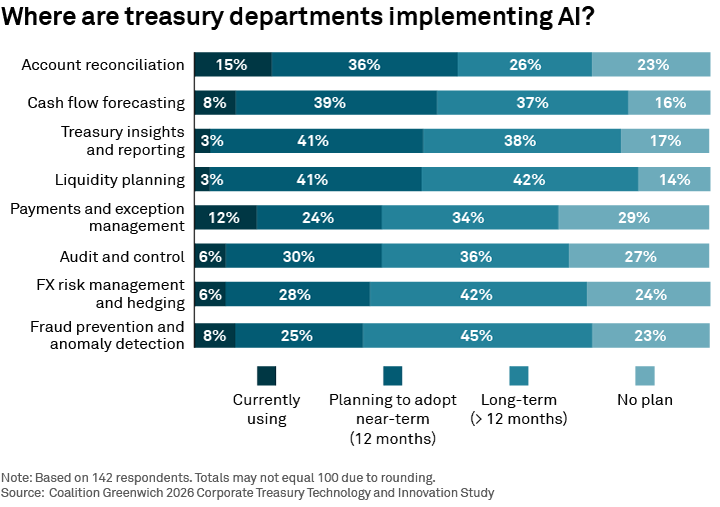
At the first stage, AI supports general productivity through tasks such as summarizing documents. At the next stage, it helps identify patterns and exceptions, such as categorizing cash flows. Only a small number of treasury departments have progressed to using AI to influence liquidity, funding or hedging decisions.
That is likely to change, and fast. Treasury leaders are planning to expand their use of AI as they seek to increase capacity without expanding their teams at the same pace.
From automation to transformation
Many current AI applications are transactional. They automate repetitive activities, accelerate processes and help treasury professionals manage large volumes of information.
However, the longer-term opportunity is to redesign how treasury operates. AI can help organizations rethink processes and allow treasury teams to focus on higher-value work. It can be used as a business transformation technology rather than simply another automation tool.
Companies may therefore need to do more than add AI to existing workflows. Treasury processes, data structures and controls may need to be redesigned before advanced applications—including autonomous or “agentic” AI—can deliver reliable results. This is particularly important because organizations that move directly toward autonomous agents without addressing underlying processes and controls could struggle to achieve consistent outcomes.
Data, trust and integration remain barriers
Limited in-house expertise, integration complexity and data security concerns are slowing adoption. Treasuries also need confidence that AI outputs are accurate, transparent and appropriate for financial decision-making.
The risks are significant. An inaccurate forecast, payment recommendation or hedging proposal can have financial, operational and reputational consequences. For this reason, explainability and human oversight will remain important, particularly when AI is used to support decisions involving liquidity, funding, hedging, or significant payments.
Data is the foundation of these capabilities. Before companies can build AI-enabled treasury functions, they need information that is accessible, structured, timely, and fit for purpose. Banks can help by providing data through APIs and other forms of connectivity with treasury management systems.
However, banks represent only one part of the corporate data environment. Relevant information may also sit within enterprise systems, subsidiaries and external data providers. Integrating those sources will be necessary to produce more complete insights.
Five ways banks can support adoption
The webinar identified five areas in which banks can help corporate treasuries progress:
- Embedded banking services: Integrating AI into existing services so treasury teams can benefit without managing separate applications.
- AI-powered tools and agents: Providing applications for cash forecasting, receivables, payments, trade, and other treasury activities.
- Data partnerships: Delivering timely, structured data through APIs and other connectivity solutions.
- Governance partnerships: Sharing expertise in risk management, security, compliance, explainability, and controls.
- Business transformation advice: Helping clients redesign workflows and operating models so AI delivers more than incremental efficiency.
Some banking applications already operate behind the scenes. Banks use AI to identify potentially fraudulent payment patterns, process know-your-customer documentation and improve client service. In these cases, the value may be measured by the outcome—faster payments, more effective fraud detection and/or smoother service delivery—rather than by the technology itself.
Other applications, such as cash forecasting, intelligent receivables and cash-flow tools, are more visible to treasury users. As these tools develop, AI agents may eventually exchange information and initiate actions across workflows. Achieving that vision will require clear controls and defined boundaries around when human approval remains necessary.
A broader role for banks
AI could give treasury professionals more time to interpret business developments, challenge assumptions and make strategic decisions. It could also strengthen the connection between treasury and the wider business.
For banks, this creates an opportunity to become broader technology, data and transformation partners. The institutions best positioned to support corporate treasuries will combine useful AI tools with expertise in integration, governance and process redesign.
The central message from the webinar was clear: AI adoption will depend on more than technology. Reliable data, redesigned workflows, strong governance, and trusted partnerships among corporate treasuries, banks and technology providers will be essential to delivering its full potential.