
How the buy side thinks AI will impact the fixed-income markets
While some new technologies show promise in the future, artificial intelligence (AI) is having a big impact now, and fixed-income investors agree.
The killer app for AI is a user interface that lets you forget how sophisticated the underlying technology is while producing output that otherwise would have taken hours to create by hand. AI has been in use in fixed-income markets for years, generating evaluated bond prices and driving quantitative trading and investing strategies. But those implementations required PhDs and complex coding. GenAI (generative AI) allows the complex underpinnings of those use cases to be put to work by almost anyone.
Data and docs
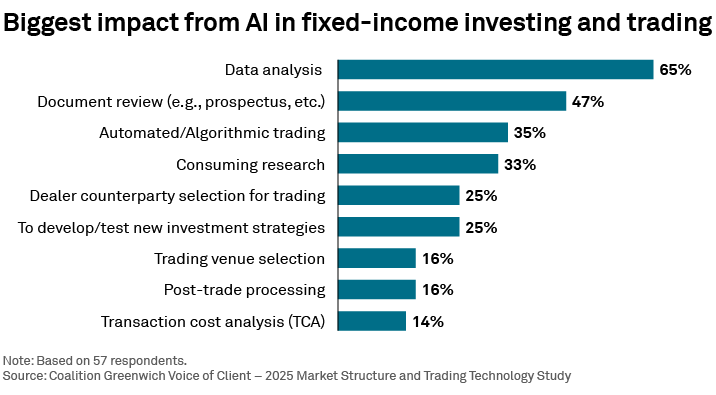
According to the 57 buy-side traders and portfolio managers we interviewed in the first quarter of 2026, AI’s biggest impact on fixed-income investing and trading is data analysis and document review, cited by 65% and 47%, respectively.
We concur. Commercial solutions from LTX and the newly launched AIQ Markets allow users to easily search through TRACE data to find pricing patterns, create a portfolio with given criteria and seek out bonds to trade based on liquidity scores, yields, ratings, and just about any other attribute you can think of. More tools like this will surely hit the market in the months ahead.
Second, AI coding assistants allow users to quickly analyze large sets of trading data with limited knowledge of Python or other languages proficient in data processing. With the right setup, it’s simple to tell your coding assistant where data is located and what trends you’re seeking, enabling it to create charts and statistics that would have required hours or days of manual effort in Excel. This approach can also prove quite valuable for product managers who can now build working prototypes rather than writing functional specification documents when asking IT to build new internal or client-facing apps.
And then there’s document review—one of the original GenAI use cases. Bond prospectuses tend to come in similar formats and contain similar information, which makes it an easy task for AI to summarize, compare and contrast. While technology has long existed to help portfolio managers analyze this data, AI makes the data available faster and in whatever context is needed.
The same approach holds true for research. Buy-side firms reading sell-side research often want to understand the key points before committing time to read the details. AI is doing this now, in some cases with the results already embedded into the report to save the reader time.
Trading, sort of
About one-third of respondents said AI would have the biggest impact on automated and algorithmic trading. When capital markets professionals consider automation and AI, trading is often the first thing that comes to mind. And while AI is certainly capable of making trading suggestions and decisions, actually putting that “thinking” to work in the institutional market is much easier said than done, with regulatory concerns the biggest roadblock.
If AI makes a trade and something goes wrong, blaming AI for the bad choice won’t placate regulators or the end client. Remember, whereas coded software solutions follow explicitly programmed rules to make a decision, AI makes decisions by learning patterns from data and adapting its responses. In other words, software will make the same decision each time when presented with the same information, while AI will not. This lack of determinism leaves senior executives, risk-takers and compliance officers skeptical.
Our study participants also noted that AI will also impact dealer counterparty and trading venue selection. In the short- and medium-term, these use cases are what will likely drive more AI-assisted automated trading rather than true AI-native algorithms. We know this to be true as these solutions already exist, some from the trading venues, some from the execution management system (EMS) providers and the rest as internally built systems at quantitative investing and trading firms. AI can suggest approaches for trading based on historical data, but those suggestions are then fed into coded solutions (or to humans) that take a more deterministic approach to making trading decisions.
Don’t fade AI
Don’t fade AI in fixed income. Its ability to transform data analysis, research, portfolio construction, and more is very real and with us today. Those who use it creatively and safely maintain an edge. But for now, let’s leave the trading to old-fashioned computer code and humans.