

Table of Contents

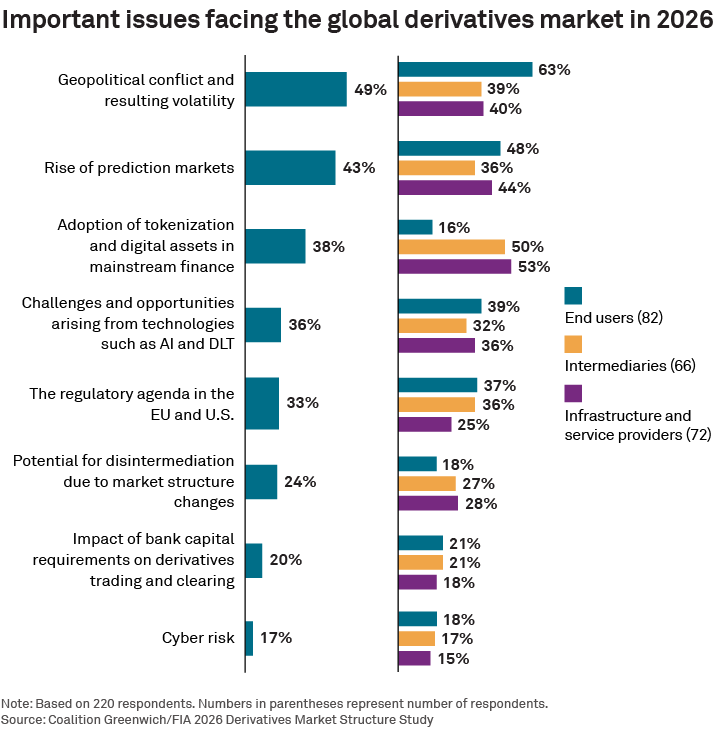
Change is constant in the derivatives market, but the drivers of change are not. The factors that are most important to the 220 derivatives market participants in our study this year are geopolitical conflict, prediction markets and the adoption of digital and tokenized assets by traditional finance institutions. The regulatory agenda, which had been a top concern in the past, has dropped to fifth place on the list.
Geopolitics
The geopolitical environment, which has been a consistent driver of derivatives market activity over the past few years, has become less stable. This environment may cause volatility to spike, asset prices to move in unexpected ways and the cost of trading to fluctuate. This will naturally concern end users, who generally prefer greater stability.
End users are, therefore, most concerned about geopolitical stability. Sixty-three percent of those respondents cited it as the top issue, while by contrast, just 39% of intermediaries felt the same. For the intermediaries, an increase in volatility and volume can be good for business, as most are ultimately paid on turnover. But regardless of your place in the ecosystem, these market conditions are often when derivatives show their true value. Whether used to speculate on market change or protect against uncertainty, derivatives markets thrive when volatility reigns.
Innovation
Our research indicates that prediction markets and tokenization, which were a more minor part of the story just a few years ago, are now top of mind for the derivatives industry.
Prediction markets have arguably become the biggest story in derivatives markets since Bitcoin Futures launched in 2017. The new regulatory environment in the United States has become more friendly to these contracts, and the recent addition of sports-based event contracts is fueling exceptionally rapid growth. On the other hand, our research shows that there are concerns about reputation risk. Prediction markets can be used to wager on everything from basketball games to armed conflict, creating an intersection that worries some market participants.
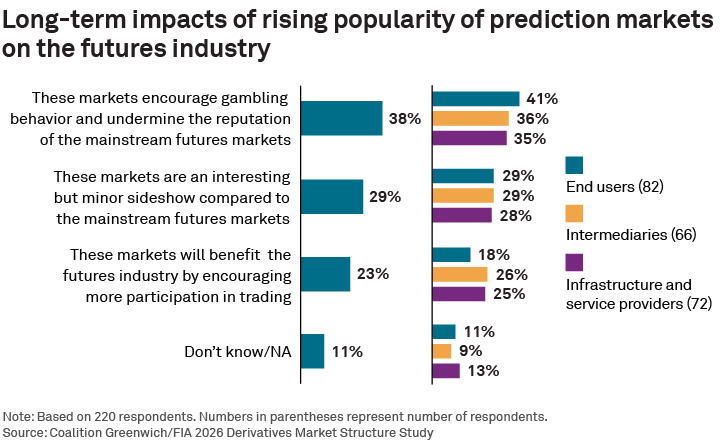
Thirty-eight percent of respondents state that prediction markets encourage gambling and undermine the reputation of the futures market, with a plurality of both end users and intermediaries stating as much. Even more telling is that there has been a year-over-year increase in negativity about these markets. The number of respondents with a negative view on prediction markets increased 10 percentage points from a year ago (from 28% to 38%). This may be a result of the rapidly increasing growth of prediction markets, which has magnified concerns about the potential for insider trading and market manipulation.
Judgments aside, prediction markets are becoming a more integral part of the futures industry, and 23% of respondents believe prediction markets could provide benefits. In this same research, nearly half of respondents state they are watching these markets with interest to potentially enter them, and an additional 15% are planning to enter them in the near future. This is a fast-growing segment, making this is an area that is difficult to ignore.
At present, activity in prediction markets is dominated by retail traders. Consequently, institutional investors and others on the buy side may view these markets as too shallow for trading. On the other hand, they do think the data from these markets are useful inputs (for a deeper discussion, please see Prediction markets: It’s all about the data).
Tokenization and digital assets are another hot-button issue for both the entire financial services industry and the derivatives industry specifically. Intermediaries believe that tokenization is the most important issue facing the industry, ahead of geopolitics and prediction markets. End users, however, are much more sanguine about the impact of tokenization, with only 16% citing it as a top issue for the derivatives market. Given the importance to other market participants, end users should not overlook the role that tokenization will play in the market.
While the impact of this trend extends beyond futures, within the futures industry, the use of tokenized assets to improve collateral management is seen as a game changer. In fact, the respondents in our study ranked it ahead of the integration of artificial intelligence (AI).
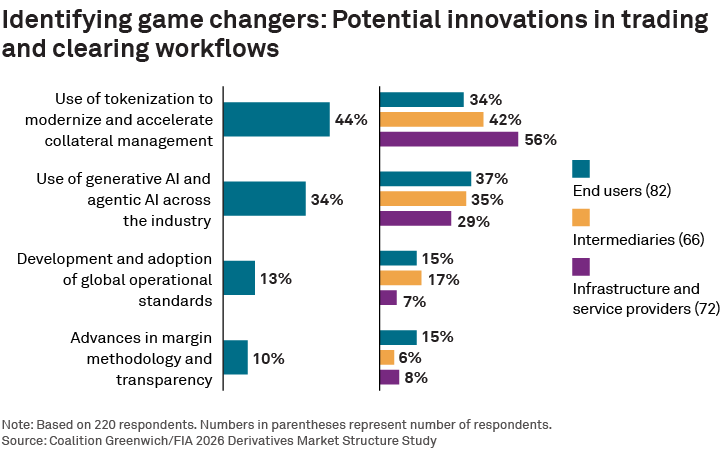
While end users may be more skeptical about tokenization overall, 34% believe that incorporating it into collateral management could be a game changer, nearly the same percentage as AI.
Tokenization can improve multiple elements of the collateral management process, including operational efficiency and capital efficiency. With markets moving to 24x7 trading, the ability to move collateral on weekends and holidays will help manage the risks of 24x7.
This is no longer purely theoretical. There are many initiatives now under way to explore the use of tokenization to enhance the collateral process. Participants in this ecosystem include both digital-native firms, such as Canton Network and Circle, and traditional financial market intermediaries, such as DTCC and Tradeweb.
Tokenization is especially relevant for exchanges, clearinghouses, other infrastructure operators and service providers. Fifty-six percent of the respondents from these firms cite tokenization as the main game changer, which arises from their role in building and supporting tokenization capabilities for the industry. Intermediaries and end users are more split between the potential of AI and tokenization.
By contrast, in research conducted in 2023, the development and adoption of global operational standards was considered the biggest game changer—this year, it is third. Both tokenization and AI can help improve operations; the focus on how to achieve operational improvements has shifted away from standards to new technologies.
While a backdrop of global uncertainty cements the importance of derivatives for investors, end users and traders, innovation is setting the stage for what might become a transformational period for the industry. Event contracts, barely visible only a few years ago, are now one of the industry’s fastest growing segments. And tokenization, which was virtually unheard of only a decade ago, now seems poised for mainstream adoption. The final outcomes in all cases are unknown, of course, but the impact of these and the other items cited by our study participants will be critical to the future of the derivatives market.
Stephen Bruel is a Research Director on the Market Structure & Technology team.
MethodologyThis report is based on interviews conducted between January and February 2026 with 220 derivatives market participants and experts sourced from the Crisil Coalition Greenwich network and the FIA community. The research includes findings from 66 people working at clearing firms, brokers, swap dealers, and other intermediaries; 82 working at asset managers, hedge funds and other end-users; and 72 working at exchanges, clearinghouses, other market infrastructure operators and service providers. The majority are focused on exchange-traded derivatives, but many are involved with cleared OTC derivatives, such as interest-rate swaps. Questions explored the key drivers of change in the derivatives market, the impact of innovation and the relationships between market participants.