

Table of Contents

Once a niche academic concept at the University of Iowa, prediction markets have gained significant traction in the past year, as we noted in our Top market structure trends to watch in 2026. Platforms such as Kalshi and Polymarket sparked the current global fascination with prediction markets, and now exchange giants—CME, Cboe, and Intercontinental Exchange (ICE), which has invested in Polymarket—along with major brokerage firms like Interactive Brokers and Robinhood, are further driving the industry forward.
The reasoning is simple. By tapping into the “wisdom of the crowd,” prediction markets promise unique signals about the future. Users can trade contracts on the outcomes of specific, real-world future events such as Federal Reserve decisions, CPI rates, employment figures, gas prices, GDP growth, and even the purchase of autonomous territories in the North Atlantic, all tradeable 24/7 at your fingertips.
The potential has not gone unnoticed by market participants constantly seeking an edge in a data-driven environment. For them, prediction markets represent a novel alternative and supplementary dataset that can help separate signals from noise. Consequently, major exchange operators are exploring the space, recognizing the potential to offer their users not only tradeable instruments but also new market data streams. This growing interest suggests that widespread institutional adoption may be a question of when, not if.
To gauge sentiment on the Street, Crisil Coalition Greenwich conducted a flash study of 53 U.S.-based market structure specialists (including buy- and sell-side traders, market structure analysts, business heads, market data experts, fintech providers and other well-informed professionals) on the potential impact and value of prediction markets for institutional trading. Respondents all have a focus or interest in market structure, and so we feel their collective view provides unique insight into market expectations going forward.
It’s all about perception
The first widely recognized modern prediction market was the Iowa Electronic Markets (IEM), launched by the University of Iowa in 1988. Designed as an educational and research tool, the IEM allowed market participants to trade contracts based on political elections and other events. Its success in forecasting election results helped popularize the idea that markets could be used to predict real-world events more accurately than traditional polling or expert analysis.

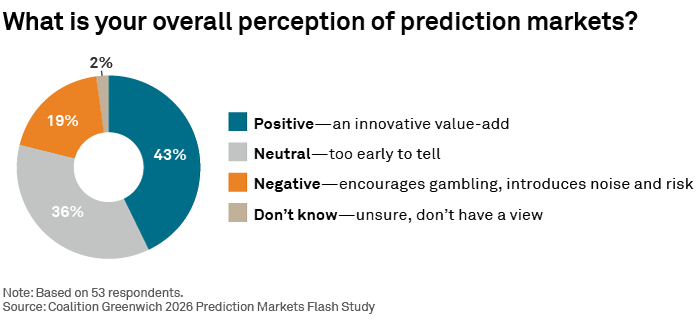
Nearly 40 years later, prediction markets have become a cultural phenomenon, and, like other phenomena, the community is unsurprisingly engaged but divided. In fact, with just 2% of study participants unsure or lacking an opinion, almost everyone had a view one way or the other.
A plurality, 43%, expressed a positive view, citing the innovative nature of these platforms and the potential value they could add to the marketplace. These specialists see prediction markets not just as a new trading platform but as a promising new tool for information aggregation and forecasting, capable of providing unique, alpha-generating insights.
However, a third (36%) of them maintained a neutral stance, believing it’s too early to tell the true trajectory of prediction markets. Meanwhile, only a fifth (19%) held a distinctly negative view, feeling these markets encourage gambling and introduce additional risk noise rather than actionable signals.
One of the biggest concerns we hear is liquidity. The wisdom of the crowd only works when you have a crowd, and many of the economic and political contracts listed on the major markets remain thinly traded. The market’s momentum suggests this will change over time, but we all know liquidity begets liquidity, and starting that virtuous cycle can be tough.
Speculating on speculating
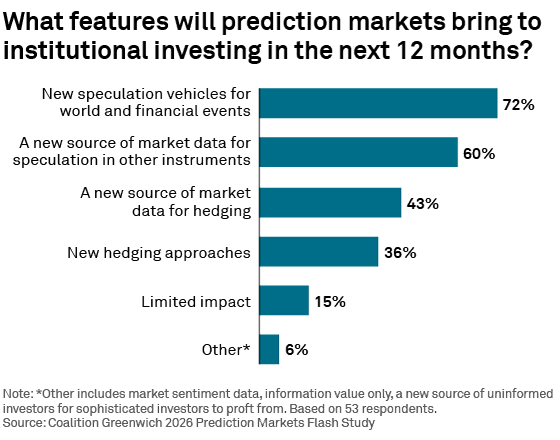
Despite current liquidity concerns, nearly three-quarters of our respondents believe prediction markets will bring new means of financial event speculation to institutional investors in the next 12 months. One professional noted the value of trading around politics and economics, such as an administration change, which could affect portfolio valuations. Whereas traders today might use interest rate or equity index contracts to position around such events, tomorrow some may decide to simply position based on a binary outcome.
Additionally, 60% see them as a new source of market data for speculation. There’s a strong belief that the initial value of prediction markets will be focused on generating alpha by directly trading on or garnering insights from market outcomes. Beyond speculation, 43% of participants see them as a new source of alternative market data for hedging, and about one-third (36%) expect new hedging approaches away from traditional markets.
Just 15% remain unconvinced, expecting little impact, positive or negative, on the institutional landscape in the near future.
It’s all about the data
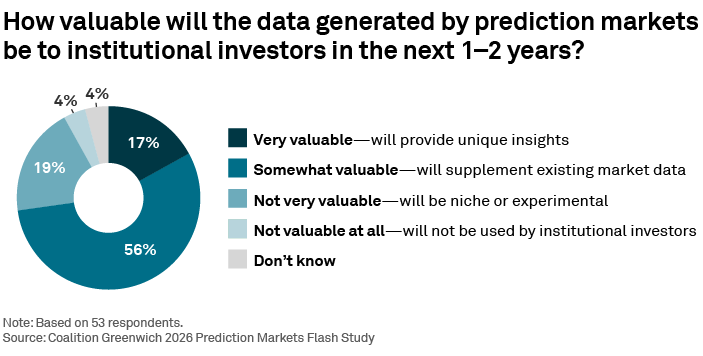
Looking ahead over the next two years, over half (56%) of respondents believe the data generated by prediction markets will be at least somewhat valuable. They expect it will supplement existing market-data feeds with additional color and context. Another 17% view this data as very valuable and capable of providing unique, hard-to-find insights. Combined, nearly three-quarters of respondents anticipate prediction market data will hold tangible value for institutional investors in the near future.
However, skepticism looms. About one-fifth (19%) of these specialists don’t expect prediction market data to be very valuable. Instead, this group feels it will remain a niche or experimental dataset with limited practical use. An additional 4% dismiss it as “not valuable at all” and see no role for it in institutional trading, while another 4% didn’t have any opinion. Again, liquidity (or the lack thereof) is the deciding factor. Low liquidity doesn’t only mean wider bid-ask spreads, but in this case, less reliable and signal-producing data.

Conclusion
While prediction markets are transitioning from an academic experiment to an emerging asset class that provides valuable data, the path to mainstream institutional adoption remains uncertain.
A majority of capital markets professionals see potential in prediction markets platforms, primarily as new instruments for speculation as well as novel sources of market data. Looking one to two years ahead, most believe this data will become a valuable supplement to existing feeds.
However, this enthusiasm is tempered by skepticism. Concerns that prediction market contract trading is more akin to gambling than to sophisticated forecasting means capital markets professionals will be tasked to prove their value before major investments, whether that be in technology or the capital needed to trade, can be made.
Ultimately, market participants must be able to identify which prediction markets data delivers the “wisdom of the crowd” and achieve successful outcomes when trading those contracts or other instruments based on that data.
Jesse Forster is a senior analyst on the Market Structure & Technology team.
MethodologyIn January 2026, Crisil Coalition Greenwich conducted outreach to 53 market structure specialists in the United States (including buy- and sell-side traders, market structure analysts, business heads, market data experts, fintech providers, and other well-informed professionals) on the potential impact and value of prediction markets for institutional trading.