

Table of Contents

Over the past decade, the U.S. institutional investment consulting industry has been reshaped by a series of seismic trends, including consolidation, the rise in adoption of the outsourced chief investment officer (OCIO), the entry of private equity as owners, and the integration of consulting with wealth management and registered investment advisor (RIA) firms. Today, the industry is starting to see the impact of the next big driver of change: the growth of private markets and the potential integration of public and private assets in institutional investment portfolios.
Consolidation and concentration
Eighty-five percent of U.S. institutional asset owners use investment consultants for help with manager selection, performance monitoring, asset allocation, OCIO, and other services. Following the global financial crisis in 2008, a wave of mergers and acquisitions has altered the universe of consultants competing for those relationships. M&A transactions have brought together some of the biggest names in the industry, and these acquisitions have started to break down the boundaries between institutional and wealth channels, bringing the capabilities and scale of institutional consultants to wealth.
The result of this deal-making has been a steady increase in market concentration. Although asset owners continue to make use of a host of specialist and boutique consultants for narrow assignments, the top 15 consultants in the U.S. market now advise on a striking 90% of U.S. institutional tax-exempt assets.
The newest variable: Private markets
Today, those leading consultants face a new variable as they fight to maintain relationships and woo new institutional clients. The rise of private markets is changing the composition of manager searches and the very nature of core consulting functions, such as performance monitoring and asset allocation advisory. As a result, it is also changing what institutional asset owners are looking for in their consultants.
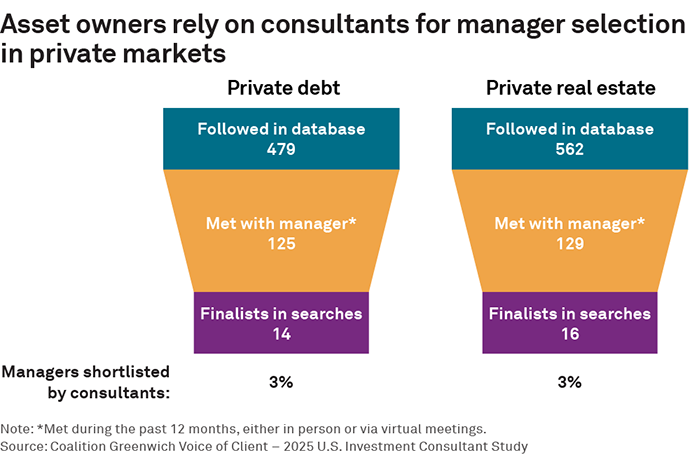
The graphic above illustrates the challenge facing both asset owners and consultants as allocations shift to private markets. Many asset owners, particularly those new to private assets, are less familiar with asset classes such as private equity, credit, infrastructure, and real estate, and the universe of managers available in these categories. As shown in the chart, that universe includes hundreds of managers in private debt and private real estate.
Institutions are relying heavily on their consultants for support and advice not only for help in narrowing down potential managers and awarding mandates, but also for assistance in valuing and monitoring opaque private assets and integrating them into their allocation frameworks.
Investment consultants of all sizes will need to build out their capabilities in these areas to compete for the growing share of mandates originating in private markets. We believe the need to meet institutional demand in private markets will be a driving force for M&A activity and the broader evolution of the investment consulting market in the decade to come.
Best Investment Consultants of 2026
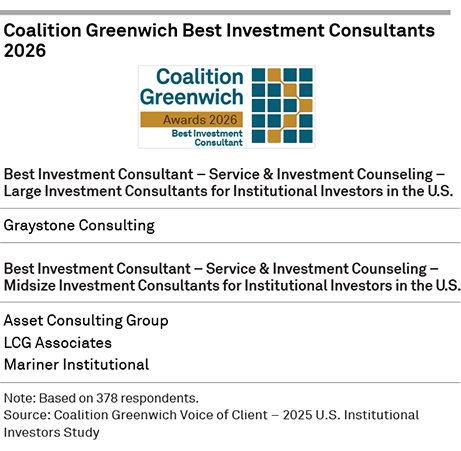
Every year, Crisil Coalition Greenwich interviews hundreds of U.S. asset owners about their investment consultants. Asset owners are asked to name the consultants they employ and rate them in a series of categories, including investment philosophy and beliefs, understanding of the client’s goals and objectives, quality of asset allocation advice, capability of individual consultants, and the timeliness and quality of client service. Consultants who receive ratings topping those of competitors by a statistically significant margin are named Coalition Greenwich Best Investment Consultants.
The tables below present the complete list of 2026 Coalition Greenwich Best Investment Consultants in Service & Investment Counseling in the U.S.
Mark Buckley, Global Co-Head of Investment Management, and Noam Cotton, Relationship Manager, advise on the investment management market in the United States.
MethodologyBetween February and September 2025, Crisil Coalition Greenwich conducted interviews with 698 individuals from 573 of the largest tax-exempt funds in the United States. These U.S.-based institutional investors include corporate, public, union, and endowment and foundation funds with either pension or investment pool assets greater than $150 million. Study participants were asked to provide quantitative and qualitative evaluations of their asset management and investment consulting providers, including qualitative assessments of those firms soliciting their business and detailed information on important market trends.