
The unwritten rules of consultant relations: Sales and ratings
In an increasingly crowded and complex investment landscape, asset managers face a daunting challenge: winning the trust of investment consultants who play an outsized role in guiding the flow of institutional capital.
Consultants serve as the gatekeepers to the institutional marketplace. However, while as many as 9 out of 10 North American institutional allocators across public defined benefit plans, endowments and financial institutions rely on these intermediaries, many asset managers have not yet mastered the playbook on how to successfully engage consultants.
In this series of blog posts, we will reveal the unwritten rules of consultant relations. These rules come not from us, but from the world’s most influential consultants themselves. Every year, Crisil Coalition Greenwich conducts candid interviews with researchers and consultants from top-tier consulting firms globally. This year, we are distilling insights from those conversations into a series of lessons and recommendations about how to build fruitful partnerships with consultants and secure their coveted ratings. Looking at these “unwritten rules,” it’s clear that many asset managers will need to rethink how they introduce products, differentiate their strategies and navigate consultants’ rigorous due diligence processes.
How to introduce new products: Purpose over proliferation
Successfully introducing a new product to an investment consultant rarely happens through a cold, product-specific pitch. The graphic below helps explain why. Across asset classes, U.S. consultants are solicited by thousands of asset managers every year. Of those, only a relative handful make it to consultant short lists.
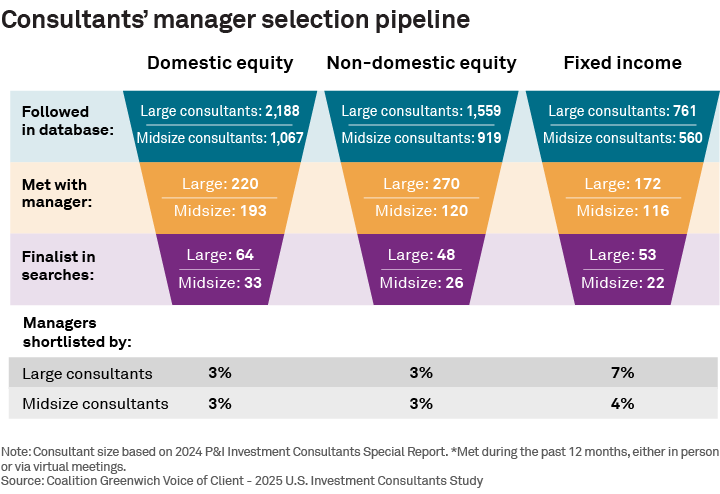
In the face of that level of competition, a cold pitch is unlikely to pay off for managers. Instead, success usually comes from leveraging an existing relationship and demonstrating a deep understanding of the consultant's specific client base.
Although it can take years to develop and demonstrate that level of understanding, there are small and easy things that asset managers can do to show they are trying. One consultant participating in this year’s research emphasized that “the one thing that always starts things off on a little bit of a better foot is when [an asset manager] has spent the time to figure out who the right person is to talk to.”
Before those conversations even begin, asset managers need to know if the new product they are promoting aligns with the consultant’s overall approach and immediate needs. Consultants prefer innovative solutions that demonstrate a deep knowledge of their clients’ requirements. They want to see that a new product addresses a specific need or fills a gap in the market. “It’s probably better for [an asset manager] to be looked at as a partner who is trying to solve our needs,” one consultant noted. “Hopefully, we can find a product that we need that they are in the process of promoting or selling.”
One smart way for asset managers to ensure alignment is to seek input from consultants during product development. Consultants in the study estimate that about 10–15% of managers ask for feedback early on in the product development process. The number of managers seeking consultant feedback “has definitely grown in recent years,” said one consultant, “in part due to the rise of OCIOs,” for which asset managers “might have to tailor [their] product offering.” Another consultant noted that in the past 12 months alone, about 20 to 30 managers sought input on new products. “Managers look to us to ask questions about what to include in the strategy they’re putting together—things like guidelines, terms or fee structures,” he said.
Overall, success in winning consultant support for a new product depends on building trust, understanding the consultant’s clients’ needs, and involving consultants early in the development process to refine the product for the institutional market.
The evaluation engine: What consultants really consider
Asset managers aiming for strong ratings from investment consultants should focus on the “Three P’s” of philosophy, process and people. Consultants want to understand a manager’s investment philosophy, assess the repeatability of the process, and gauge the quality and stability of the team. As one consultant explained, “We make sure the philosophy makes sense, that they're able to execute on that philosophy, and that their process is a sound one.” Another highlighted the importance of meeting the investment team in person. “The tenure of the team is important, for sure—that is No. 1,” he said.
Beyond investment credentials, client service and communication are critical. Consultants value managers who are responsive, accessible and proactive in providing information. “How responsive are they about providing new information that you need?” asked one consultant. Firms track and remember manager interactions—both formally and informally—with long-term notes on responsiveness and relationship management. “Consultants are like elephants; they have long memories,” another consultant advised.
Finally, firm stability, ownership, and operational ease matter. Consistency in team structure and clear alignment of interests are closely scrutinized. “Ownership structure, incentive and compensation structure, and the decision-making process are important,” noted one consultant.
In short, to build trust and secure favorable consultant ratings, asset managers should present a stable team, communicate clearly and ensure operational processes are smooth.
Unforced errors: Common mistakes in pursuing a rating
Asset managers often undermine their pursuit of consultant ratings by failing to understand individual consultant processes and requirements. Rushing the process or relying on sales pitches instead of providing transparent and accurate information can damage credibility. “Just getting a meeting with us is not going to lead to a rating,” warned one consultant.
When asset managers do land a meeting, consultants expect them to come prepared, respect their time, and stay focused during discussions.
One major misstep is bypassing consultants to contact clients directly. This approach erodes trust and can significantly harm a manager’s chances of securing a rating. Consultants value partnership and integrity, and expect managers to maintain proper communication channels. When it comes to triangulating directly with institutional investors, one consultant said, “I want to hear from my client. I don't want to hear from you,” advised one consultant.
Finally, distribution professionals should be concise and avoid dominating meetings. “If you're taking up more than 10 to 15 percent of the time at most as an RM or institutional sales professional, there's a decent chance I'll kick you out of the room,” noted one consultant.
Consultants appreciate managers who are aware of their coverage, avoid unnecessary outreach, and understand the nuances of the relationship. A thoughtful, transparent and respectful approach is essential to avoid unforced errors and build lasting partnerships.
Conclusion
Winning over investment consultants requires a shift from a pure sales perspective to a partnership mindset. Successful asset managers introduce products that solve real problems, maintain strict capital discipline, articulate a clear and honest edge, and respect the rigorous, independent nature of the consultant due diligence process. By avoiding common pitfalls and focusing on transparency, asset managers can build the trust required to turn initial meetings into long-term, meaningful partnerships.