
Treasury tech tools: Legacy systems and fragmented data architectures are primary barriers to scale
In our last two blog posts, we examined corporate treasury department adoption rates and investment plans for artificial intelligence and other new digital tools. Despite corporate executives’ enthusiasm for these innovative solutions, companies still have real work to do on internal systems and data governance improvements before they can integrate AI and other new tools at scale into corporate finance and treasury operations.
As shown below, about 40% of corporate treasury departments run on multiple enterprise resource planning (ERP) systems with limited integration.
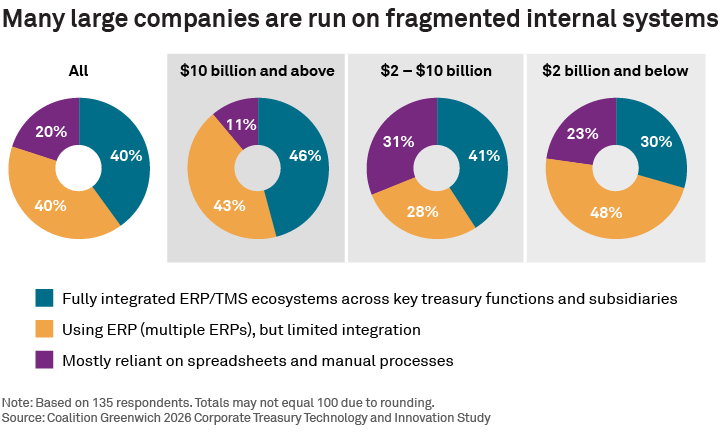
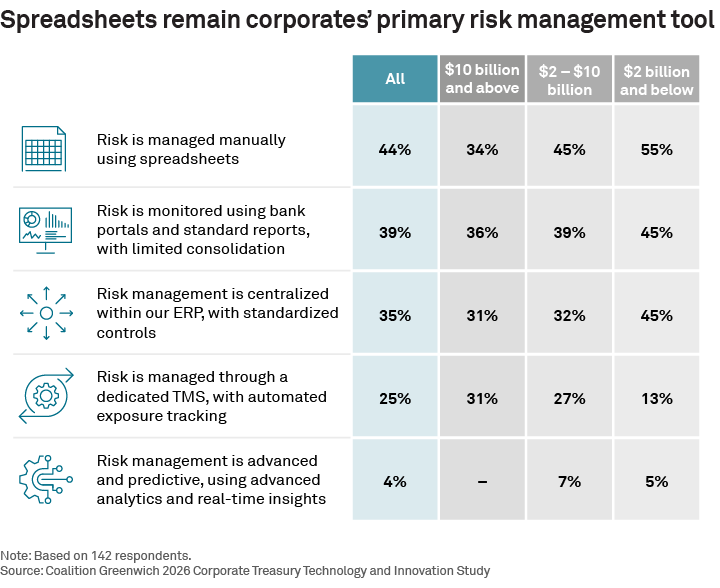
In addition, about 1 in 5 large corporates are still run on spreadsheets and manual processes, and spreadsheets still linger as the baseline technology used in corporate risk management processes (as shown below).
The following graphic illustrates that companies recognize the need to modernize these systems, and they are moving to address the issue. Automating manual processes, eliminating spreadsheets, and integrating ERP, treasury management systems (TMS) and banking systems all rank among treasury departments’ top stated priorities.
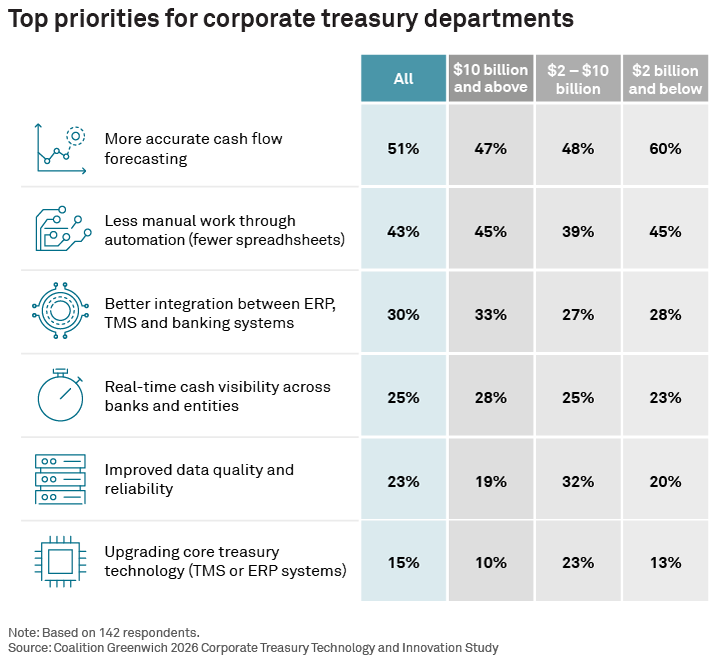
However, our research suggests that some companies could be taking a misstep as they work to adopt and integrate new technology. Less than a quarter of large companies overall and only about 1 in 5 of the largest and smallest corporates name improving data quality and reliability as a top priority for their treasury departments.
Normalized, reliable and timely data is the key that unlocks the power of AI. Currently, many treasury tech initiatives are focused on process automation and other relatively simple and isolated applications. These tactical objectives are generally achievable with current levels of data availability and quality.
Yet, to implement predictive analytics and other sophisticated AI solutions at scale, companies will need much more and much better data. Integrating and breaking down barriers between ERP, TMS and other systems is a first and necessary step in securing that data. But it’s not enough. As companies look to adopt new tools and modernize treasury operations, it is imperative to create comprehensive data management and governance platforms that operate across integrated systems. Only then will companies be able to unleash the full power of AI and other innovative solutions.