

Table of Contents
Introduction
Sustained growth in wealth management firms is heavily shaped by two inputs: advisor will and advisor skill. To achieve growth, advisors must be motivated to expand beyond the current scale of their practices and equipped with the skills to do so effectively—understanding which strategies and tools to employ, and how to execute them consistently.
This report sets out a practical road map for wealth firms to build the intent and capability for growth—helping advisors translate these into tangible results at both the practice and firm level.
At a headline level, the wealth management industry does not appear to have a growth problem. Over the past decade, assets under management (AUM) by North American wealth managers more than doubled, representing an annual growth rate (CAGR) of roughly 10%. However, much of those gains can be attributed not to organic growth in advisor practices but to market performance. As an example, the S&P 500 providing a total return CAGR of roughly 15% during this period. In fact, based on our proprietary data, we see that organic growth only accounts for about 30% of total AUM growth.
The result is a modest 3% organic growth CAGR for the industry over the last decade, hidden under a period of historic market appreciation that may slow or reverse at any time.
In this report, we tap into our deep reservoir of proprietary data drawn from North American wealth management clients to help firms and advisors accelerate growth. By identifying the characteristics and strategies of the fastest-growing firms, we’ve distilled these insights into a clear set of actions that others can take to build a more effective and sustained growth engine.
Stages of growth
For any wealth advisor, the most effective strategies for growth will vary depending on where that advisor is in the life cycle of his or her career and practice. We define the advisor journey as having three distinct phases, from licensing to retirement:
- Phase 1 (0-10 years): Building a foundation. In the earliest stages of an advisor’s career, the emphasis is on establishing a viable practice by winning households as clients. During this phase, the advisor’s top priority is building a durable foundation of assets and, in some cases, hitting prescribed hurdles set out by their employer. This is accomplished by designing and communicating an attractive proposition capable of driving client acquisition. At this early stage, the advisor is learning how to execute, and growth is driven primarily by persistence or will. Often, the early career advisor is less discerning in whom they will work with as clients.
- Phase 2 (10-20 years): Scaling a practice. A decade into a career, execution becomes the biggest driver of growth. Although client acquisition remains important, the advisor’s ability to deliver on his or her value proposition becomes key to new priorities like deepening relationships, retaining clients, optimizing the client mix, and scaling the business.
- Phase 3 (20+ years): Maturity and succession. After achieving significant scale, advisors tend to diverge into two groups: those that drift into maintenance mode, servicing an existing and (hopefully slowly) atrophying client base before monetizing the book, and those that remain in growth mode, diligently executing to retain clients while continuing to add new relationships and scale the practice further.
The chart below shows how the wealth industry breaks down into these advisor phases and AUM. The first insight that jumps out from the chart is the fact that wealth advisors are an aging group, with half of them exceeding 20 years of tenure, and only 1 in 5 currently in their first decade. Some of this may be explained by the growing prevalence of team-based practices, as more younger advisors may jump-start their career by beginning as an associate with larger, more established advisors.
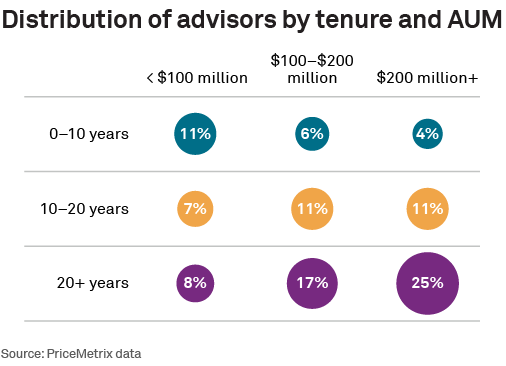
Equally as interesting, however, is the extent to which asset levels vary across and within age cohorts. Half of advisors with tenure between 0-10 years have $100 million in assets, and 40% of those have $200 million in assets.
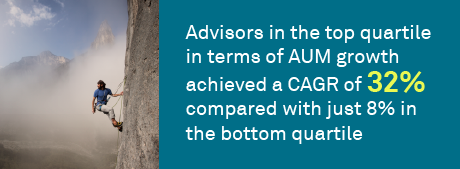
Because rates of growth and the effectiveness of specific growth strategies vary significantly depending on advisor tenure and book size, we focused our analysis on a single cohort: advisors with 10–20 years of practice experience and AUM between $100 million and $200 million as of 2022. From that starting point, we tracked growth over the subsequent three-year period. The results reveal how dramatically growth rates diverge among advisors. Advisors in the top quartile achieved a 32% CAGR in AUM growth—four times higher than the 8% delivered by those in the bottom quartile. When you remove the impact of market growth, the difference is even more pronounced.
Drivers of growth: Will and skill
An analysis of data from this cohort reveals a set of common traits and practices among advisors and firms with strong rates of growth. These characteristics each fall under the umbrella of the two prerequisites for wealth management growth: will and skill.
The will to grow
Wealth management firms must cultivate the will to grow among their advisor teams. This starts at the very beginning of the recruitment and hiring process. Wealth management firms that have achieved high rates of growth understand the importance of hiring highly motivated established advisors. To achieve this goal, many of them use analytic tools that enable firms to quantify and rank the growth potential of individual advisors.
For example, at PriceMetrix, we created a tool that aggregates a series of practice growth metrics and distills results into a single growth propensity score. The higher the score, the more likely the practice will grow. Client firms use this score to compare the growth prospects of potential hires and determine both whether to make an offer, and how much money they should offer to recruit a candidate. In addition, by investing in programs that improve growth drivers, firms can be confident that they will experience improved asset gathering.
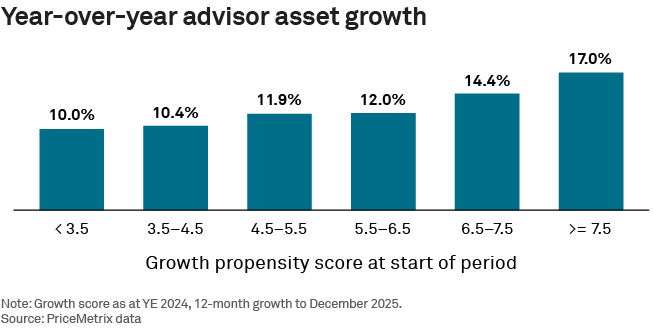
This type of tool can be applied at both the individual and organizational level. Wealth firms contemplating an acquisition should evaluate the potential target firm according to the aggregate growth propensity of its advisor base, significantly improving the due diligence and valuation process. Likewise, firms in discussion with individual advisors looking to retire and sell their practices should be using growth propensity score to help determine the attractiveness and valuation of the practice.
Bringing in advisors with a healthy appetite for growth provides a solid foundation. But the next and probably more important step is building a set of incentives that keeps the existing advisor team motivated to grow. Wealth firms with high growth rates create compensation structures specifically targeted at driving growth.
Across the wealth industry, compensation plans at employee firms have become increasingly sophisticated and intelligent, with corresponding improvements in efficacy. Traditionally, compensation plans rewarded size. As advisors grew their practices, they gained a larger share of their production as take-home pay. Over time, plans evolved to focus less on absolute size and more on growth. To incentivize advisors at every career stage and practice size, firms now award bonuses for activities such as adding new assets and new clients, working as a team, and for overall practice growth.
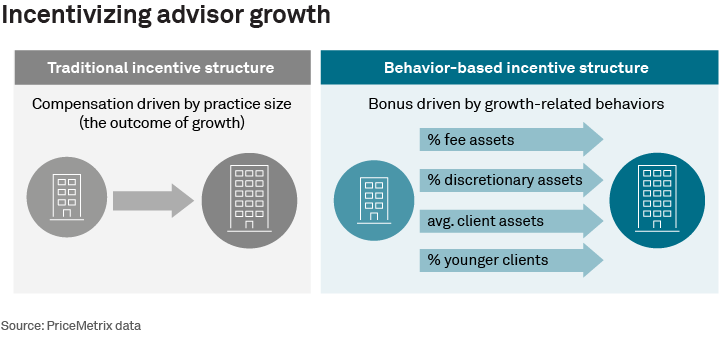
Firms that have achieved high growth rates have adopted these bonus structures and, in many cases, supplemented these incentives with behavior-based compensation plans that reward not only results, but the inputs that drive growth (see preceding graphic). In other words, instead of just rewarding advisors for getting bigger, many high-performing firms started rewarding advisors for the behaviors that help them get bigger. That can include:
- Increasing the share of the practice’s fee assets
- Increasing share of discretionary assets
- Increasing average client size
- Attracting younger clients
Incentivizing these behaviors embeds them into advisor practices and company culture, putting in place what organizations hope will be a durable growth engine.
Of course, many organizations, such as independent firms and some RIAs, do not have a compensation lever to pull. One of the reasons these firms appeal to advisors is that they allow advisors to operate at their own pace. That doesn’t prevent these firms from utilizing growth analytics to incentivize behavior. On the contrary, some high-growth firms are using tools like the growth propensity score to gamify desired behaviors as a means of motivation. By measuring and publicly ranking growth-related business practices, these firms are looking to tap into the most human of traits: the drive to keep up with and outperform peers.
So, what are the growth-related business practices that high-performing firms are incentivizing through compensation structures and gamification strategies? And why do the above behaviors lead to higher growth? The following section addresses developing the skills advisors need to grow their practices.
The skills to grow
Our research reveals a set of characteristics and behaviors common to advisors with the highest rates of AUM growth. We believe advisors and wealth firms can create an engine for sustainable growth by adopting a framework that includes the following skills:
- Optimizing investment/service model and client mix
- Optimizing client demographics
- Adopting a team-based operating model
- Focus on financial planning
Optimizing investment/service model and client mix
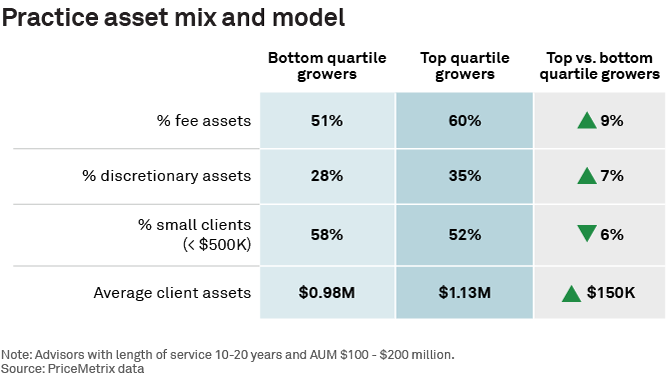
Decisions about whom to serve and how to serve them have a huge impact on advisor growth rates. Within our focus cohort, advisors with the strongest growth rates have a higher proportion of fee assets than slower growers, at 60% of assets compared with 51%, as fee-based business tends to correlate with higher client retention. They are also more likely to have adopted a discretionary (i.e., Rep as PM) management model, with top growers reporting 35% discretionary assets compared with 28%.
Top-growing advisors are also more selective about whom they bring on as clients, carrying fewer small clients, and wealthier clients overall. Advisors with a larger concentration of wealthy clients benefit from better and more referrals. (For additional insights on how advisors can boost growth rates by optimizing asset mix and model, see our report Moneyball for advisors.)
Optimizing client demographics
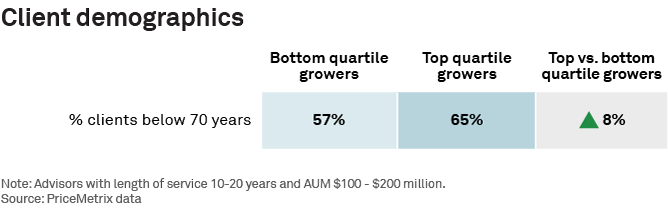
The demographic makeup of the client base has a profound impact on overall growth rates. The simple reason is that clients grow at different rates, based on where they are in their saving and investing journey. Looking again at our focus cohort, top growers have younger client bases, with 65% of clients younger than 70 years, as opposed to the 57% of under-70s in the slower-growing group. (For a deeper analysis of how client base demographics impact growth rates, see our report The fountain of growth.)
Adopting a team-based operating model
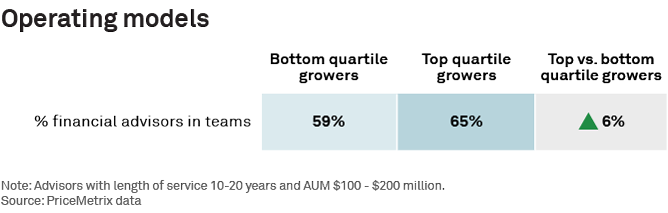
Teams outperform sole practitioners in just about every business performance metric, including growth. That conclusion is unequivocal, as detailed in our earlier report, A winning formula – teams in retail wealth management. Given that clear datapoint, it should come as no surprise that top growers in our cohort were more likely to operate in a team-based model than slow growers.
Focus on financial planning
Financial planning capability is highly correlated with advisor growth. Advisors in the top quartile for growth are 1.3x as likely as bottom quartile advisors to offer financial planning services, a finding that reinforces the role of planning as part of a broader, advice-led growth model.
A framework for growth
Adopting an organizational framework based on traits and practices common to the highest performing advisors will help both advisors and firms execute on strategies proven to drive growth in advisor practices. For advisors, that means taking into account all the aforementioned growth drivers on display in high-growth practices. And it also means taking a strategic marketing approach to your practice that takes into account current client wants and needs:
- Identify a clear target market with enough current or future financial complexity to merit professional guidance.
- Establish a deep understanding of the problems of clients within that target market and focus on the things that matter most to them.
- Build a scalable process that enables you to consistently deliver that value proposition to affluent clients.
- Strategize on when you and your practice might benefit from a team-based advisor approach, what those proof points are, as well as what you can bring to other practices.
- Hone your communication skills and process, which could be as important as your investment management skills and much more difficult to outsource.
- Use financial plans as a tool to identify unmet current and future needs. Be the center of your clients’ financial lives. Develop a professional network to match your clients with any outside expertise they need.
- Cultivate a healthy intake pipeline of prospects, ideally with those at various points in their investing journey.
Wealth firms may want to:
- Provide tools to advisors that help them across the core functions of communication, investment management, building and leveraging a financial network, prospecting and lead generation, and business scaling.
- Encourage advisors to grow their practices using a combination of compensation, gamification, teaming, and succession planning.
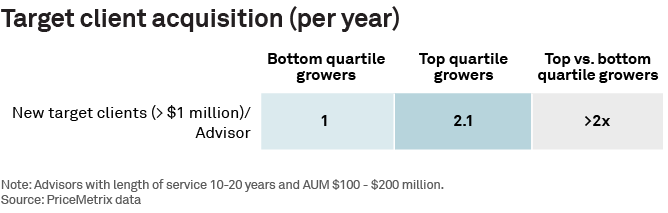
Together, these strategies help advisors and firms add not just more clients, but the right clients. The following graphic shows how advisors committed to these sound growth practices outpace their less motivated and effective peers when it comes to bringing in the most affluent clients.
Conclusion
Advisors with the will and skill to execute the strategies outlined in this report can build a sustainable engine for organic growth. Likewise, wealth firms that put in place structures to foster this intent and equip advisors with the tools to succeed can create an environment that supports consistent growth at an organizational level.
Critically, organic growth cannot come at the expense of existing clients. High-growth advisors and firms do not divert time and resources away from clients in order to attract new business; rather, they attract new business because they invest in delivering a consistently high-quality client experience. A healthy, growing practice is ultimately more compelling to both existing clients and prospective ones.
Kieran Bol and Anjali Singh advise our wealth management clients in North America.
To view the French version of the report, click here.
MethodologyThis report is based on the PriceMetrix proprietary database collected from wealth management firms across North America (U.S. and Canada). Our data includes detailed client holdings and transaction information from over 80,000 advisory practices. Because data is refreshed continuously, PriceMetrix offers an unmatched view into the behaviors and characteristics of wealth management clients, and insights into how advisor decisions affect growth and client outcomes.