

Table of Contents

Self-directed investment accounts are now a fact of life for financial advisors. In today’s marketplace, most full-service advisors serve some clients that also maintain self-directed accounts. In some cases, presence of these accounts could be an indicator of product or service needs that aren’t being met—advisor-led clients that also have a self-directed account are 67% more likely to consider switching or leaving their advisor than advisor-only clients. However, not every ‘hybrid’ relationship is at risk. For advisors, understanding each client's motivation for holding self-directed accounts can help them to improve the quality of their advice and drive both client engagement and retention. For wealth firms, understanding which of your clients fall into this category and why, can help ensure you optimally evolve your product and service offerings, and deepen share of wallet.
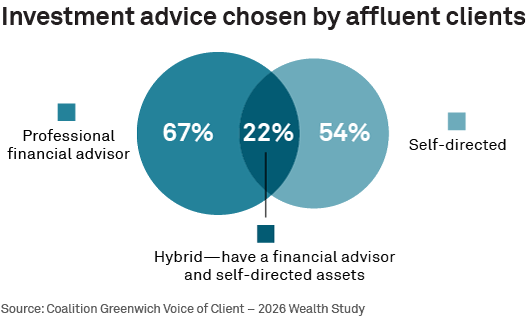
About 67% of affluent consumers have used a financial advisor in 2026. During the same period, about 54% of affluent consumers (those with up to $5 million in investable assets) have used self-directed accounts. That means roughly 22% of affluent consumers use both advised and self-directed accounts.
To help advisors understand these “hybrid” clients, we tapped into data from our 2026 Voice of Client Wealth Study, which analyzes insights from more than 5,000 wealth management clients, to create a 360-degree view of client characteristics, behaviors and preferences. We focused our analysis on clients with $2 million to $5 million in investable assets to isolate the effects of the different advice preferences.
Some of the results from that research illustrate the challenge these clients can pose to advisors. As we will show in this report, advised clients who also have self-directed accounts are more price-sensitive and less bought into the value of holistic advice. A self-directed account can be an early indicator of relationship risk, but only when it is linked to dissatisfaction, value concerns or active consideration of alternatives. In general, hybrid clients are more likely than other clients to switch firms, and less likely to follow an advisor to a new firm.
However, our analysis also shows that, in some cases, the presence of a self-directed account is not an indicator of trouble for the advisor. These clients might place a high value on the service and advice they receive from their advisor and be open to increasing the share of assets housed in the accounts with their advisor over time.
The key is knowing when concern is merited. Advisors must understand their clients’ motivations for using a self-directed account and create a strategy that equally meets the needs of both pure advisor-led and hybrid clients. In our view, that strategy should be one of full transparency: In the age of DIY investing, advisors must cultivate open relationships in which clients are comfortable discussing their complete financial picture, which will position the advisor to provide comprehensive advice that takes into account all assets—including those with the advisor and elsewhere.
Understanding the motivations of clients using self-directed accounts
Understanding the preferences of both advisor-led clients and self-directed investors can help advisors become more effective in prospecting and relationship management.
Our analysis shows that some common stereotypes about self-directed investors are not necessarily true. For example, investors who use self-directed accounts are not younger than advisor-led clients; the average age among both groups is 63. Also, one might expect the do-it-yourself investor to be more risk-taking, but in fact, the risk profiles of the self-directed and the advisor-only clients are very similar, with hybrid clients displaying the highest appetite for risk.

These findings illustrate why it’s important for advisors to get past stereotypes and superficial judgments and understand why some of their clients decide to use other accounts.
Our research highlights four common reasons why clients with a financial advisor also use self-directed accounts.
Not sold on the value of advice
Not all hybrid clients are convinced about the value of holistic investment advice. As one would expect, a majority of advisor-only clients say they prefer to work with an investment professional who can holistically meet their financial needs across investments, life insurance, banking, and taxes. Less than half of hybrid clients prefer this approach. In fact, investors currently using only self-directed accounts are just as open to a holistic advisor-led relationship as hybrid clients. This result suggests wealth firms and financial advisors might have more luck than they think winning over self-directed investors with a comprehensive advisor-led offering.

Greater cost sensitivity
Hybrid clients’ skepticism about the value of advisor-led relationships makes them less open to the idea of paying a premium for advice and more open to experimenting with low-cost robo-advice.
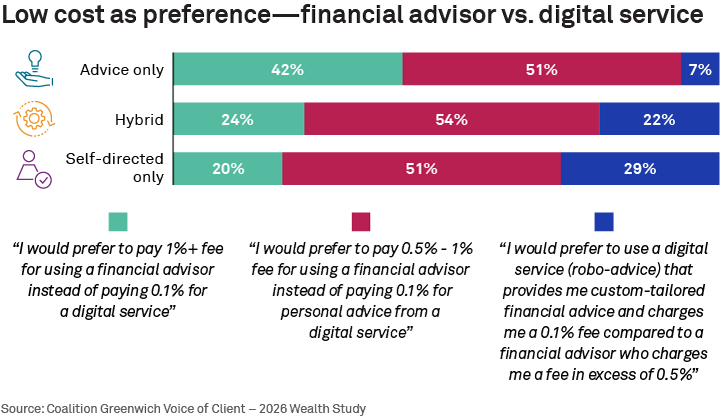
For some clients, maintaining both account types may reflect uncertainty about the relative value of advisor-led and self-directed investing.
Hybrid investors are also three times as likely as advisor-led clients to say they are open to robo-advice, making them more open to solicitations from lower-cost digital advisors and services.
Enjoying DIY
Some clients just like picking stocks. For these clients, a separate self-directed account can be both a source of enjoyment and a way for them to stay engaged in the markets and their own portfolios. These accounts might also be a venue for investors to own more exotic assets such as crypto that might not be available or considered a good fit for their advisor-serviced accounts.
Dissatisfaction with the advisor
A client might open or maintain a self-directed investment account because he or she is unhappy or not satisfied with some aspect of the advisor-led relationship, such as investment performance, quality of advice, service quality, or availability/responsiveness of the advisor, breadth or quality of investment options, or other factors.
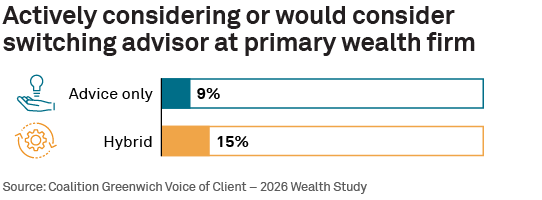
In these cases, self-directed investment accounts can be a relationship red flag because hybrid clients are more likely to become at-risk accounts. Hybrid clients are at a notably higher risk (than pure advisor-led clients) of leaving their advisor. Among study respondents, 15% of hybrid clients say they are actively considering or would consider switching primary advisors, compared to only 9% of advisor-only clients, a 67% greater likelihood.
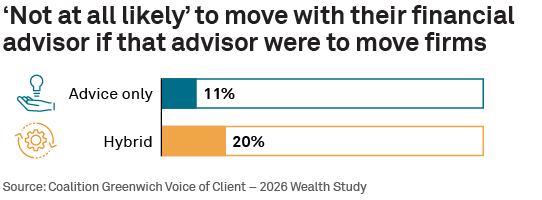
Hybrid clients are also much less likely to stick with an advisor who moves from one firm to another. Twenty percent of hybrid clients say they are not at all likely to move assets and go with their current advisor to a new firm, compared to just 11% of advisor-only clients.
For advisors: Engaging with hybrid clients
As a modern wealth advisor, you should accept that some portion of your clients will maintain self-directed investment accounts, and that the advisor-led account will not necessarily hold all client assets. Given this reality, what are the most important strategies for advisors to adopt in servicing hybrid clients?
1) Discover. Ask about assets held elsewhere. Holistic planning and investment advice takes into account all client assets, wherever they reside. When clients are willing to openly share information about their lives, assets and financial situation, they benefit from better advice and better outcomes.
2) Diagnose. When discussing assets held elsewhere, seek to establish the client’s motivation. Establish a rapport where your clients are comfortable talking about all their assets and accounts. To build that level of openness and trust, advisors should demonstrate to clients that their top goal is helping them achieve their goals, not convincing them to move assets into the advisor-led account.
3) Demonstrate. Articulate the value created through holistic planning. Have regular conversations with clients about the value you create with your specific wealth management approach. Feel comfortable talking about price and ROI at the same time.
4) Monitor. Implement a system that can highlight early warning signs of client dissatisfaction. If you conclude that the presence of a self-directed account may be a relationship red flag, seek to understand where you are falling short of your client's expectations. By delivering better service and advice, advisors might be able to assuage some of the concerns that led the client to establish a self-directed account in the first place.
For firms: Business strategies for hybrid clients
Wealth firms figuring out strategies for dealing with the significant number of clients with self-directed accounts should consider the following specific actions:
1) Identify and address product or service gaps. If your clients have a higher than normal propensity to hold self directed accounts, diagnose the root cause. Perhaps there are platform or product gaps, or your advisors may not be well equipped to articulate and deliver on the value that holistic planning can offer.
2) Consider offering self-directed accounts or lower-cost digital advisory services. Although many advisors are concerned about cannibalizing full-service advisory business by providing lower cost or DIY options for clients, the fact is that self-directed investing is here to stay. Many clients don’t see maintaining a self-directed account as conflicting with having an advisor. Some just like to invest on their own or want to diversify some of their assets into multiple accounts as a means of minimizing costs or managing risk. These clients are going to access self-directed venues somewhere. By keeping these accounts in-house, the advisor both retains assets for the firm and makes it easier to track client assets across accounts.
3) Use digital tools that provide critical insights about clients. Advisors today have access to powerful digital tools that can help them understand the behaviors of their clients across their entire financial landscapes, including assets held elsewhere. Having a more complete picture of a client’s finances puts advisors in a better position to determine clients’ motivations for using other advisors or accounts, including self-directed investing. These insights can help advisors pinpoint accounts that warrant special attention, due to either attrition risk or growth potential, and inform strategies to strengthen and deepen advisor-led relationships.
Kieran Bol, Nathaniel Brown and Harpreet Kaur advise our wealth management clients in North America.
MethodologyThis report is based on data from the Coalition Greenwich Voice of Client – 2026 Wealth Study, which is the most comprehensive deep dive into the needs, wants and behaviors of today’s wealth management client. Data is collected via direct feedback from over 5,000 individual investors, including representation from the affluent, high-net-worth and ultra-high-net-worth household segments. Insights come straight from wealth management clients themselves, collected through surveys, panels and individual interviews. Over 60 distinct named wealth service providers are represented, helping providers evaluate specifically where their firm stands out.
For this report, an "affluent consumer" is defined as having $100,000 – $5 million in investable assets. The definition of selfdirected assets is based on respondents having retail investments with the following firms: Fidelity, Vanguard, Charles Schwab, E*TRADE, Merrill Edge, or Robinhood. Preference questions are based on a 1-6 scale, where 1 is “Strongly disagree/Not at all likely” and 6 is “Strongly agree/Extremely likely,” depending on the question.
For more information, visit Wealth Insights—Voice of the Client | Coalition Greenwich.