
The corporate banking paradox: If technology makes diversification cheaper, will consolidation still pay in efficiency?
For years, the case for consolidating banking relationships has been compelling.
Corporate treasury teams face constant pressure to streamline operations, reduce complexity and do more with fewer resources. Consolidating banking relationships can streamline cash management, deepen strategic partnerships and channel more business to banks providing essential credit commitments. Accordingly, the average number of banks used by large U.S. companies for credit has fallen significantly since 2019.
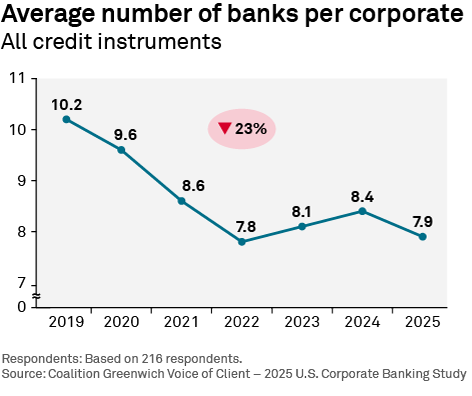
Yet, the trend contains a paradox: Companies are reducing banking relationships as technology makes a diverse provider network easier to maintain.
The consolidation story
The forces driving consolidation are familiar. While large corporates generally retain strong access to capital and alternative sources of financing, treasury teams are increasingly focused on reducing operational complexity and controlling costs.
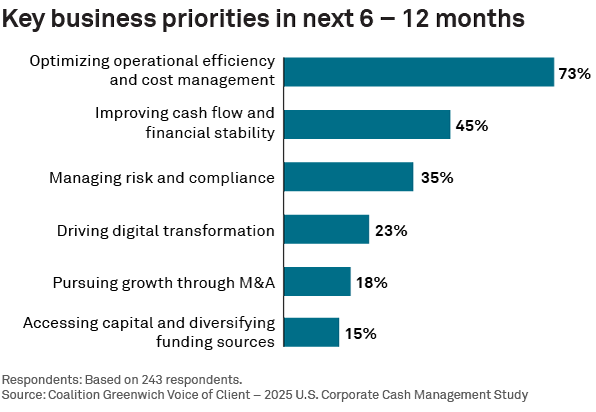
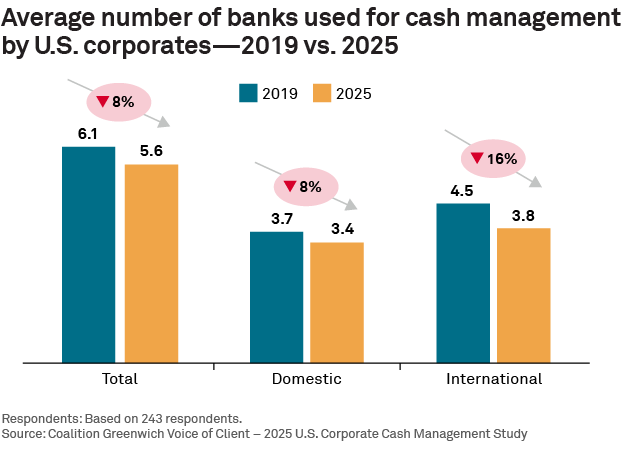
As a result, many companies have concluded that they can safely concentrate business among a smaller group of core banking partners. This consolidation is also supported by the increasingly broad capabilities of leading U.S. banks, which can meet more corporate needs through a single relationship and reduce reliance on specialist providers. The benefits are tangible: Fewer relationships to manage, simplified treasury operations and deeper engagement with the banks that matter most to the organization.
The technology shift few are talking about
However, another trend is unfolding beneath the surface.
Historically, each additional banking relationship brought significant onboarding, connectivity, integration and maintenance costs. Those barriers are beginning to fall.
Most corporates still use traditional host-to-host connections, but API adoption among large U.S. companies rose from 21% to nearly 30% in one year. Connectivity upgrades also rank among treasury teams’ highest technology priorities.
Modern connectivity is making it easier to add regional banks, fintechs, payment providers, and other specialists alongside global banks. Onboarding is becoming less resource-intensive.
In the meantime, technology is reinforcing consolidation. Banks are embedding their platforms more deeply into treasury workflows, helping the broadest and most seamless providers capture more business. Technology lowers diversification barriers even as it makes core relationships harder to displace.
Diversification no longer has to mean complexity
Traditionally, companies faced a trade-off between efficiency and diversification. More providers meant more resilience, but also more complexity. Fewer providers delivered simplicity, but concentrated risk.
Technology is steadily changing that equation.
As connectivity improves, companies may be able to retain the risk-management benefits of diversification without bearing the full operational burden. Maintaining a handful of secondary banking relationships, once viewed as inefficient, could become far more practical.
The question treasury teams should be asking
The objective is not to reverse consolidation.
For many companies, concentrating business among trusted core banking partners remains entirely rational. However, treasury teams should challenge themselves to think beyond today's operating environment and consider how resilient their banking structures would be during periods of disruption.
If a credit disruption, market shock, bank merger, or service issue emerges, how quickly could alternative providers be activated? And would those providers already be integrated into key treasury workflows?
In the past, maintaining those options came at a significant cost. Increasingly, that is no longer the case.
The irony is that companies are consolidating relationships just as technology makes diversification easier. The most forward-looking treasury organizations may be the ones that recognize they no longer need to choose between efficiency and flexibility.