
The unwritten rules of consultant relations: Client service and relationship management
In our first blog post in our series on the unwritten rules of consultant relations, we presented insights and recommendations designed to help asset managers increase their odds of success when commercializing with and trying to obtain a favorable rating from investment consultants. Here in Part 2, we will extend that analysis to the challenge of establishing and maintaining strong partnerships with consultants that pay off over the long term.
Every year, Crisil Coalition Greenwich interviews researchers and consultants from the world’s top-tier consulting firms. In these conversations, we consistently hear one refrain: Consultants are drowning in incoming communications from asset managers.
That complaint is the No. 1 insight asset managers should keep in mind when forming strategies for building relationships with consultants. Consultants understand that asset managers need to communicate—both on-cycle, when a manager is actively pursuing a rating, and off-cycle, when a manager needs to keep the consultant updated on developments within funds and their organizations.
Consultants want this information. They need this information. What they do not want, and what turns them off many asset managers, are generic updates and sales pitches that aren’t relevant and soak up time and resources from internal staff.
“It's not going to do any good to send us generic stuff,” explained one consultant. “We'll learn to ignore your emails. Then when you've got something important to tell us, we're not going to read it.”
Am I providing real value to my consultant?
The first unwritten rule of consultant relationship management is that asset managers should eliminate all extraneous communication to consultants. Use this simple question to determine if your message is appropriate: Does this communication add value to the consultant and their decision-making process?
If the answer is yes, send it. If the answer is no, spike it. Maintaining that discipline is not always easy for asset managers. “It's often a difficult thing to do, but most of them do find the right balance eventually. To be honest, pestering is not always the right way to go about it,” said one consultant.
The same perspective can be extended from communications to the relationship as a whole. Consultants value personalized interactions with asset managers who understand their unique needs and can provide tailored communications and solutions. As one consultant noted, “If they come in and say, 'I have a PM or the CIO or the CEO with me,' that's a productive meeting. If they have a new product rolling out or they have some new developments with their products, that's a productive meeting.”
Asset managers can gain a real advantage by being judicious about how and when they communicate. Consultants participating in the Crisil Coalition Greenwich study stress the need for asset managers to “bring your A-game” by providing thought leadership, market insights and innovative products that help them stay ahead of the curve.
Be proactive and help consultants better understand the market
While it’s critical not to bombard consultants, asset managers can also undermine their credibility by not communicating often enough. Consultants need to stay informed about any developments that could impact the manager's ability to deliver returns or affect overall investment strategy. They want updates on any significant events or changes at the firm, such as ownership, team changes or portfolio shifts.
It is incumbent upon asset managers to be proactive with communications that keep the consultant abreast of any material changes and provide transparency into investment strategy, including portfolio composition, performance attribution and process.
The key for asset managers is to view these communications not simply as a required “reporting” exercise, but as an opportunity to share insights with consultants. Updates should first deliver a concise snapshot of the key takeaways, but communications like quarterly reports and marketing materials should then go one level deeper, providing data or analysis that helps consultants gain a deeper understanding of the investment landscape.
As one consultant explained: “[We’re looking for] updates that go beyond what they are producing, and our due diligence questionnaire and the quarterly documents and any sort of annual things that they do. That’s when you want to talk to a portfolio manager to get an understanding of what's going on, big picture.”
Aiming for strategic partnerships
In short, consultants want to engage with asset managers who supply relevant thought leadership, share unique insights and provide real value to their own decision-making process. Asset managers who deliver on all those counts will strengthen long-term relationships and, in the best-case scenario, develop into strategic partners upon whom consultants rely for knowledge about markets and productsThose managers will be in a strong position to secure and maintain ratings for their funds on an ongoing basis. As one consultant explained, “[We see a strategic partner as someone] we have some type of relationship with already, who has shown that they're willing to work with us both on developing a product and on the fees and the business side of that as well.”
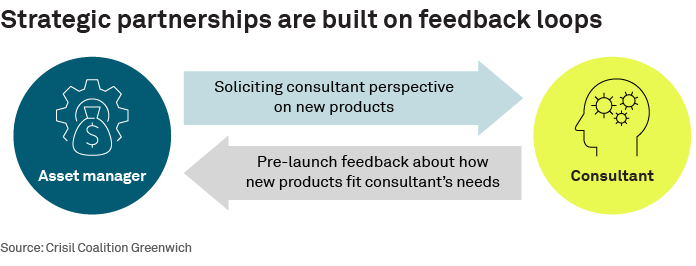
The end goal of asset managers striving for strategic partnership status is to partner with a consultant, not on a product-by-product basis, but at the enterprise level. Managers achieve that goal by cooperating with consultants at every stage of the business, especially in product development. By soliciting consultant feedback during the discovery process and before launch, asset managers can create a feedback loop that ensures final products will meet the consultants’ needs and standards.
However, even managers who never attain the role of strategic partner will improve their odds of success by following two of the most important unwritten rules of consultant relations: Don’t destroy your credibility by inundating consultants with generic communications, and make every outreach an opportunity to provide real value.