
Treasury tech tools: Companies actively invest in emerging technologies, but adoption remains uneven
Our first blog post in this series looked at how global corporates are using artificial intelligence to remake treasury operations. However, AI is not the only advancement companies are using to overhaul the treasury function. They are equally advancing on the adoption of new structures and concepts.
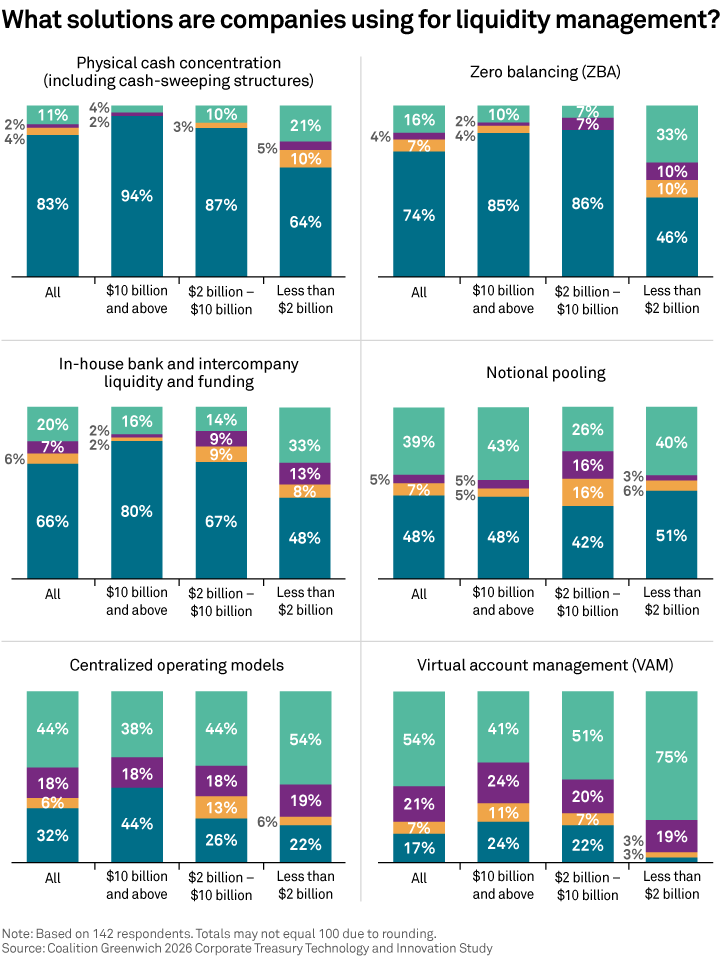
The graphic above takes a close look at adoption rates for liquidity management (LM) solutions currently available to global corporates. As the charts show, physical cash concentration, zero balancing, in-house banking, and intercompany liquidity and funding have all emerged as common LM solutions.
One thing is clear: Most of the demand for these products is coming from the world’s largest corporates that have both the need and the budget for advanced tools.
Virtual account management
The trend of higher adoption rates among bigger companies is even more apparent for a more sophisticated solution: virtual account management (VAM). VAM solutions are expensive and complex to implement. While the efficiency gains and other returns on that investment can be significant, the VAM approach remains—at least for now—appropriate mainly for very large companies with complex structures, multiple entities and operations and cash flows in multiple regions and currencies.
Even among that group, VAM could prove a tough sell for banks. Roughly 40% of companies with more than $10 billion in annual sales say they have no plans to even look at VAM solutions. That finding suggests banks might have to reduce implementation complexity and make adoption easier for corporates if they want VAM to gain widespread traction.
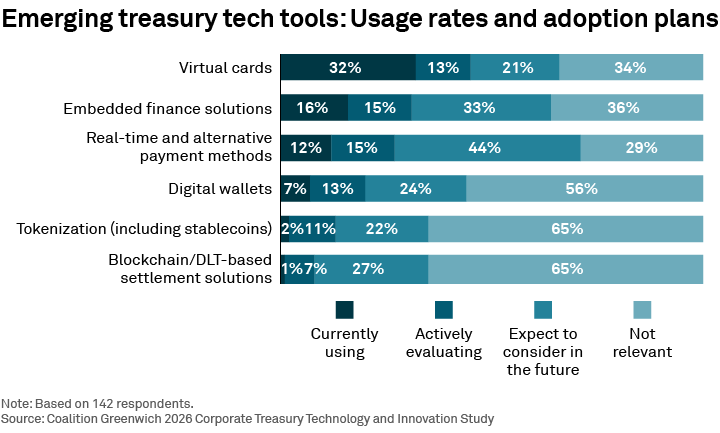
What about other new digital treasury tools and concepts? As shown in the graphic above, approximately 45% of companies are using or actively evaluating the use of virtual cards, and nearly a third are using or evaluating embedded finance solutions. Looking a bit farther ahead, roughly 70% of companies expect to consider real-time and alternative payment methods at some point. Approximately 45% of companies plan to take a close look at digital wallets, and about a third expect to consider adopting tokenization (including stablecoins) and blockchain/DLT-based settlement solutions.